



At first glance, they may seem like successful investors, but these are the most common images of men in their 20s on TikTok and on the streets. Recently, men in Generation Z have started to wear “quarter house sweaters” without wearing loose streetwear.
The Quarter-Zip is a sweater or jacket that is zipped from the neck to up to a quarter of the chest. It is similar to a polo shirt with buttons, but features a zipper that allows you to adjust the height of the collar. The dress has long been a symbol of golf wear or “financial men” on Wall Street. It was considered as a common term for business casualties because it looked formal and active when worn on top of a shirt.
It is especially popular among beginners in society because it can be formal without being as expensive or uncomfortable as a suit. According to John Lewis, a British department store chain, searches for quarter house sweaters for men have soared 425% year-on-year this year. At the center of the trend is an ordinary 21-year-old college student named Jason Yeekspee. He posted a video and declared, “I will no longer wear training clothes.” He then patted down his quarter house sweater and said, “I will wear elegant and formal clothes instead. This is how adults do it.” The video became a hot topic of conversation with more than 30.8 million views.
As such, the trend of quarter house emphasizing “safe adult male” is expanding to the overall lifestyle of Gen Z men. Young people who certify “quarter house sweaters” online show off their intelligent image by carrying around matcha latte or self-improvement book, which are symbols of British and American intellectual men.
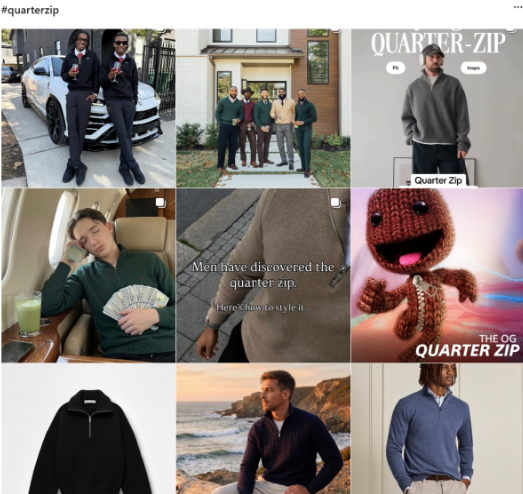
Locally, they call it LinkedIn coordination or performative male. It is not just a simple style but a way of showing off the “cool male figure” through economic stability, social success, and self-management. Companies also reacted instantly to the trend. U.S. fast food chain Wendy’s wore quarter house sweaters to its mascot and introduced Quarter Sips promotion. Chanel also wore a quarter house sweater for the opening of its new collection.
Google search volume also rose by about 2250% throughout 2025, with Polo Ralph Lauren’s quarter zip-up being the most searched. Behind the quarter house trend, there is also a resistance to the image of a “criminal” toward people of color. Nike’s “Tech Pack Hoodie,” which has been enjoyed by black young people, has been prejudiced as a clothing worn by criminals through movies and dramas.
Ola Adams, a 16-year-old boy who used to enjoy wearing a tech pack hoodie, confessed to the Guardian, “I felt people’s attitude toward me changed just by wearing clothes.” They say that the underlying prejudice is largely resolved only by “safe-looking clothes.” Some criticized it, calling it “respectful politics” that victims of racism should change to suit the perpetrator. Liza Betts, a researcher at the University of London School of Art, said, “It doesn’t matter how you dress, because the image changes differently depending on the person.”
In fact, the Chavs, which were popular among British delinquent youth in the early 2000s, wore luxury brands such as Burberry and Stone Island, but the brand’s image worsened. Betts pointed out that you don’t have to choose between the two, saying, “Even if you wear the same clothes, the meaning varies depending on the person and the situation.”
SALLY LEE
US ASIA JOURNAL

