


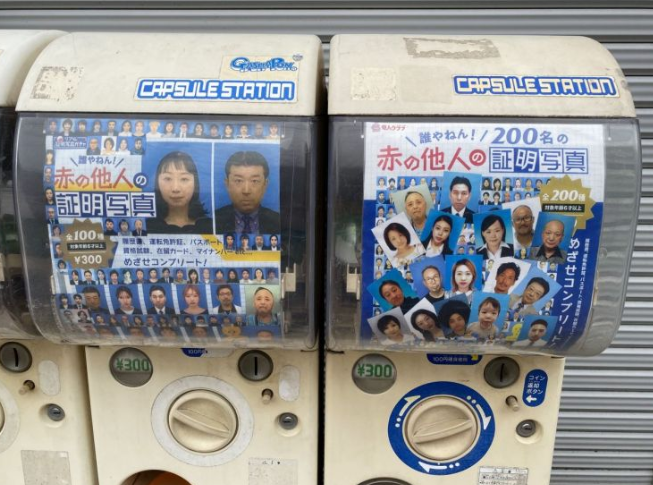
In Japan, the origin of capsule toys, a unique capsule toy is also popular. It is to draw a picture of someone you don’t know at all. It is said that taking out an ID picture of an ordinary person and putting it in the back of a cell phone case is spreading like a new trend among teens and twenties. Originally, this capsule toy machine was gradually spreading around capsule toy stores since 2022. The first person to come up with it was Hiroki Terai, who is continuing various activities such as writer and movie director. Originally, he didn’t intend to commercialize the capsule toy machine itself.
Terai says he is close to Big Joe, the cartoonist who wrote Japan’s first cook-comic “Ajihei,” the chef’s first book. I visited Big Joe’s house and he accidentally received a picture of his ID. I was thinking about where to use it and suddenly put it in a capsule toy case, and it turned out to be better than I thought. I think I would like to put it in a capsule toy, saying, “It would be fun if such a picture came out randomly.” When I contacted about 10 people around me and asked for an ID photo, they all gave me the photo willingly. At first, I use it as the subject of my movie. Terai produces a movie titled “A Walking Kenzang,” which was released in Korea under the title of “A Life Walk Orange.” The main character Kenzang makes the movie with the setting that he starts selling photos taken at ID photo shops. With the release of the movie, he left the machine on the set as an event concept. However, it has gained a lot of attention and is now in full swing.
In March 2022, a capsule toy store near Kagura-zaka in Tokyo first put the machine there and started selling it, and it became a popular SNS keyword as soon as it started. As it became popular, Terai also opened a company called “Kijin Club” that sells unique ID photo capsules and entered the business in earnest. Since its official release in 2023, it has steadily gained popularity, and now it is possible to do this in 200 locations across the country. Now, it is so popular that 40,000 ID photo capsules are sold a month.
There are currently about 500 ID photos in circulation, and 90% of them are Terai’s acquaintances. Recently, they are accepting applications from people who want to publish their ID photos. If you apply for your ID photo, the company will verify your identity and print it out in a capsule toy for distribution. However, people who are “insider” enough to submit their own photo are not very popular with consumers because they can feel the energy in the photo. There have been many series, so various versions have been released such as “Unknown Baby ID Photo,” “Unknown Golden Retriever ID Photo,” “Unknown Chihuahua ID Photo,” and “Unknown Cat ID Photo.” There have even been “Unknown Person’s Resume” and “Unknown Person’s Graduation Photo.” It has also released “Photograph of a Person Looking Like a Nominated Prisoner” by collecting only proof photos of vicious impression, which is also said to be quite popular.
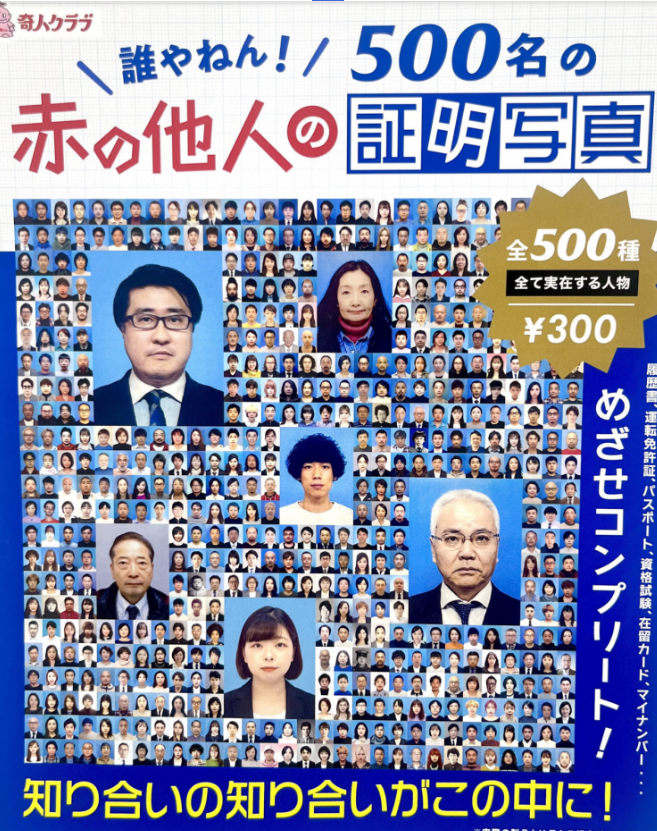
It is said that it is in vogue among young people these days to carry these ID cards behind their smartphone cases. Their favorite photo is ‘the picture of an old man looking sad or grimacing.’ Popular photos were once sold for 40,000 yen on a used trading site and are said to sell out quickly. Currently, the most popular photo is Mansour, an Iranian shopkeeper who runs an izakaya in Iidabashi Ward, Tokyo. He is often seen on TV as “Mansu,” and he seems to be popular for taking ID pictures. Terai hopes that this photo of a total stranger will serve as a new communication tool. He hopes to have a unique communication by looking at the back of his smartphone, saying, “Who is that?” and “Is that dog his dog?” and responding, “I don’t know whose dog it is, but isn’t it cute?”
Terai says he wants to release a photo book when 1,000 people gather for ID photos. He also wants to have an event where people can meet and see each other with a capsule toy machine. He is planning to connect people with capsule toys in the future. The founder seems to be a unique person.
SAM KIM
US ASIA JOURNAL

