



While Walmart posted solid third-quarter earnings despite President Donald Trump’s tariff policy and high prices, the Wall Street Journal (WSJ) reported on the 20th that the performance clearly shows a cross-section of the U.S. economy, where consumer polarization has become clear.
Walmart’s third-quarter total sales rose 5.8 percent to $179.5 billion and net profit rose 29 percent to $6.1 billion. The company also raised its overall earnings outlook for this year as consumers sought “cost-effectiveness and fast delivery” services ahead of the year-end shopping season.
The background of this performance is the difference in consumption behavior between low- and high-income groups. Low-income groups are reducing spending, while high-income groups continue to consume products with relatively high price competitiveness.
Walmart executives said, “The number of customers is increasing in all income brackets, and the influx of high-income brackets was the most prominent.” On the other hand, he explained that low-income consumers’ consumption shrank in the third quarter as the federal government shutdown suspended the implementation of SNAP and food stamps.
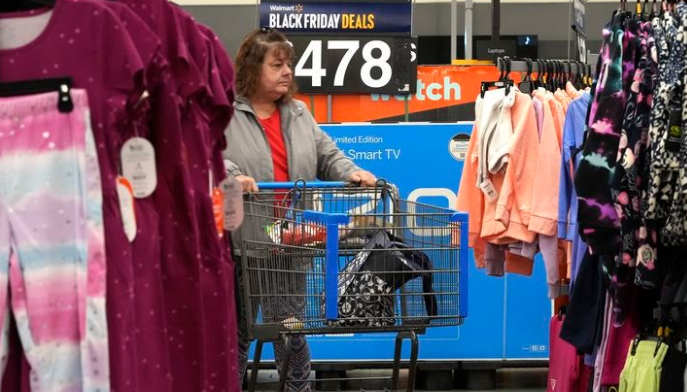
Walmart CFO John David Rainey said, “By income class, spending by low-income customers seems to have slowed down somewhat,” adding, “It’s not at an extreme level, but we’re monitoring it closely.”
The polarization of consumption in the U.S., which some economists have recently pointed out, has also been reaffirmed by this performance. According to data from the Bank of America, consumption among high-income earners rose 2.7% year-on-year in October, but only 0.7% among low-income earners. The wage growth rate also widened to 3.7% for high-income earners and 1% for low-income earners. In other words, the trend of low-wage workers, who enjoyed relatively high wage increases during the pandemic, has returned.
Recent major retailers’ performance shows a complex picture surrounding U.S. consumption. Target said existing store sales fell 2.7% in the third quarter, while Home Depot and Lowe’s also performed poorly amid slowing housing markets and uncertainty. On the other hand, TJX posted solid sales as inflation-weary consumers sought off-price stores, while Amazon posted a 13% increase in third-quarter sales to $180.2 billion.
John Furner, Walmart’s next CEO, said he expected consumption patterns during the winter holidays to be similar to those of recent years, but added that he adjusted inventory to account for high prices. He has led Walmart’s U.S. business for six years, and will officially take office as CEO in February next year.
CFO Rainey said, “The tariff impact is more limited than expected,” and that Walmart has absorbed some of the cost increases and adjusted some of them to reflect prices. Items with a high proportion of imports, such as electronics and outdoor furniture, have seen a greater increase in prices.
Meanwhile, Walmart will move its stock exchange from the New York Stock Exchange (NYSE) to Nasdaq next month. Analysts say that the relocation to NASDAQ, which is centered on technology companies, is in line with Walmart’s direction of expanding its digital business.
JULIE KIM
US ASIA JOURNAL

