


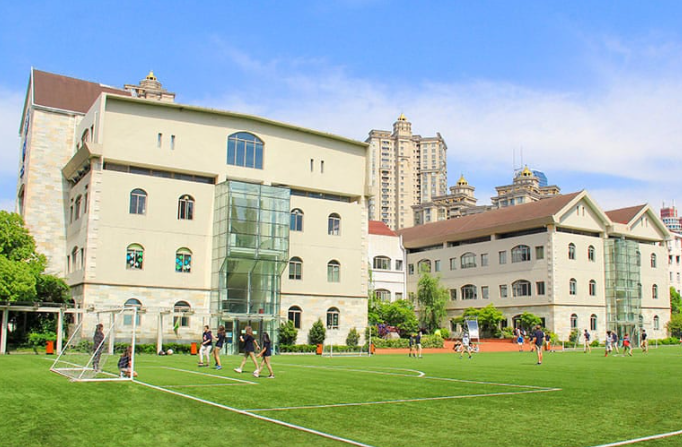
Cho, a Chinese businessman in Shanghai, recently transferred his high school son, who was attending an international school, to the school. His son went to Changning International School (SCIS), one of Shanghai’s most prestigious schools, where the competition for admission was once the fiercest among upper-class parents in China.
Cho claimed, “My son was kicked by the same class of white male students on the school playground in February and suffered ligament injuries, but the school was only in a hurry to cover up the incident.” Immediately after the incident, he asked the school for CCTV footage in the presence of the police, but the school refused.
“The school management rather forced me to sign a ‘exemption agreement’ under the pretext of depriving my son of his right to study,” he said. “I tried to stop Chinese students from saying that international schools are outside the jurisdiction of Chinese education authorities.” “These days, white students are often treated as ‘first-class citizens’ in international schools in China, and Asian children are often neglected,” he added. “How many Chinese people would accept this treatment at a time when the importance of English education is not as great as before?” The “international school craze” is rapidly cooling as poor management of international schools in China is under fire and the status of English education is not as good as before. Until just a few years ago, wealthy people in large cities such as Shanghai, Beijing, and Shenzhen were willing to pay more than 300,000 yuan a year in tuition to secure their children’s “route to prestigious overseas universities.”
Recently, however, the situation has changed dramatically. According to the Chinese Education Newspaper, the number of international schools in China has been on the decline for the first time since 2023. In particular, prestigious international schools directly operated by foreign foundations such as the U.S. and the U.K. are closing down one after another.
In June last year, Shenzhen’s Hou de Seowon, which had 1,300 students, was closed without notice. Hundreds of parents protested in the rain in March to demand “return of school expenses” when even tuition fees were not refunded. The number of international schools in Shenzhen plummeted from 69 at one point to 41 last year. The British International School Foundation, which operates nine schools across China, is also reportedly considering reducing its business in China. As the U.S.-China competition intensified and the aftermath of the COVID-19 lockdown overlapped, the decline of international schools began in earnest when a large number of experienced foreign teachers left China. “The proportion of teachers whose mother tongue is English has plummeted from 65% in 2019 to 18% last year,” said Shi Ling Study, a Chinese study abroad agency, on social media recently. The Chinese International Student Daily said, “Some international schools have reported cases of teachers being replaced three times in just six months.” Critics say that the school’s identity and educational quality are collapsing as the proportion of non-Asian students in international schools has also fallen to less than 30% due to a decrease in the foreign population.
Like Cho’s son’s case, the number of incidents of violence on campus that appear to have originated from racial conflicts has also increased. A Chinese parent who was sending his child to an international school in Beijing in 2023 posted a video of the complaint on social media and complained, “I paid 4 million yuan in tuition, but I couldn’t even stop the child’s school violence.”
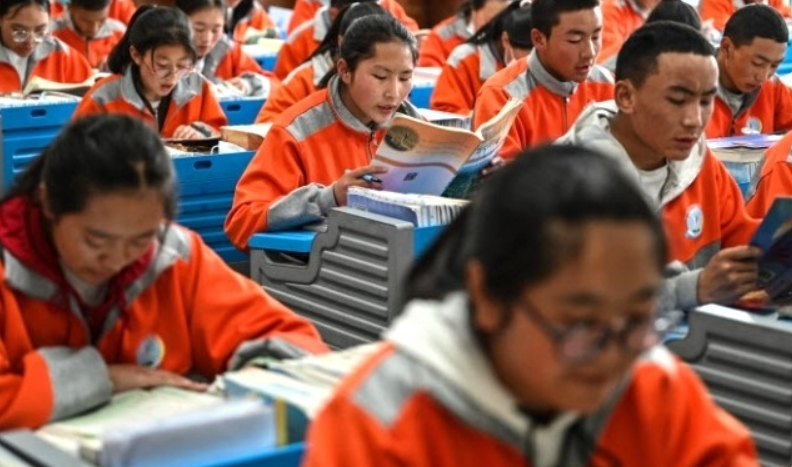
In the Shanghai parent community, there are a series of postings saying, “It has become commonplace for white students to mock Asian children in international schools.” Zhao said, “These days, international schools are bent on maintaining the image of a ‘foreign brand’ by managing the proportion of white students rather than the safety and growth of students.” Recently, there is a widespread perception among upper-class Chinese that “English is never a weapon of life.” In the past, sending children to international schools teaching in English was considered the starting point of the “global elite course,” but now more and more parents are trying to keep up with the trend of fostering science and engineering talents in China.
“What is more important than English in China now is science and mathematics,” Cho said. “In Shanghai, the number of parents who want to transfer their children to private schools that focus on STEM (science, technology, engineering, and mathematics) education is rapidly increasing.” In fact, some private schools in China are trying to transform themselves into “Chinese-style prestigious private schools,” shifting to curriculum tailored to entrance examinations at prestigious universities in Korea.
Some predict that international schools run by pure foreign foundations will become extinct like dinosaurs, and that Chinese native bilingual schools will replace them. They say that “middle and high school integrated” private schools, which teach Chinese-style math and science subjects in parallel along with high-level English classes, can be a new option for upper-class children.
JULIE KIM
US ASIA JOURNAL

