


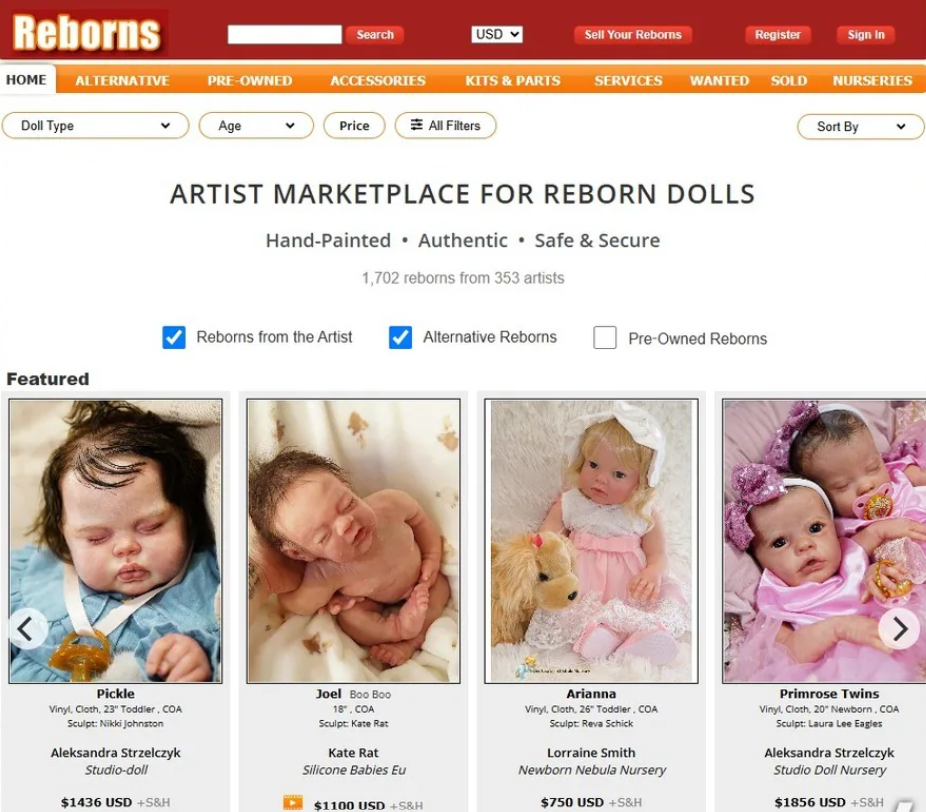
The baby doll “Reborn Baby,” which even embodies the sound of breathing, is gaining popularity among adult women abroad.
According to the Daily Mail, the doll costs up to £20,000 each. Some people ask if women are crazy about buying such dolls, but for women who have experienced miscarriages, the doll is said to have a healing effect.
Joe Miller, who lives in Suffolk, the U.K., is a mother of six children and a ribbon doll artist. She has about 20 ribbon dolls in her collection, and holds a small ceremony called “Box Opening” whenever she receives a new doll.
He said, “I don’t open all the boxes at once. I look at the baby’s feet first, look at his hands, and finally reveal his face. I feel excited as if I’m seeing a real baby for the first time.”
He runs a non-profit organization called Small Miracles, which presents ribbon dolls to people who have experienced miscarriages or newborn deaths. Miller said, “A ribbon is not just a toy. For some, it is a rest of the mind and an object of comfort.”
He said a woman in the UK was recently ridiculed for the “fake birth” incident, and that “there must be a story behind such an action” and should not be recklessly criticized.
Recently, a woman in her 20s living in Scotland used a ribbon doll to lie about pretending to give birth. The woman posted pictures of her newborn on social media and received gifts and money from her family, but the doll was found in the room and the lie was revealed.
HR specialist Jess Ellis from London is also collecting 15 ribbon dolls. After having difficulty getting pregnant due to polycystic ovary syndrome (PCOS), she started collecting dolls to keep her sense of parenting. She says, “When I take care of the dolls, I feel secure. It’s not trying to cheat someone, it’s how I control my mind.”
The ribbon doll is said to help relieve anxiety, autism and ADHD. Sharma Kroos from Suffolk bought the first ribbon doll for his autistic daughter, Teach.
“My daughter had severe tic symptoms ahead of the test, but as soon as I held the doll, my body calmed down,” he said. Teach still carries the “ribbon baby” with him dearly.
Psychologist Louise Gardder Crowley said, “The brain circuitry responsible for caring and belonging works instinctively. The act of hugging or caring for the doll promotes the secretion of oxytocin and dopamine, giving it a sense of stability,” adding, “The ribbon doll can be psychologically helpful.”
“Most people know that the doll is not a real baby, but the act of caring itself is comforting,” he said. “This is not a delusion, but a natural self-healing process in the brain.”
EJ SONG
US ASIA JOUR

