


Production lines that produce one battery cell every 1.7 seconds and significantly lower the defect rate, robots’ “postural sensors and visual recognition systems” that monitor the situation of arable soil and crops in real time, and image foundation models that select and diagnose lesions of multiple organs with a single scan… Behind these advanced smart scenarios are China’s artificial intelligence (AI)-related “patent network.”
Analysts say that China’s overall AI capabilities have made significant progress in the development of core technologies in the digital sector during the ’14th Five-Year (2021-2025) Plan’ period, making a leap forward overall and systematically. According to statistics from the National Data Bureau of China, the number of AI patents in China accounts for 60% of the world. From basic research to industrialization, from system supply to joint construction of ecosystems…AI is rapidly permeating China’s economy and society.
In the process, it is analyzed that China’s institutional guarantees are promoting innovation.
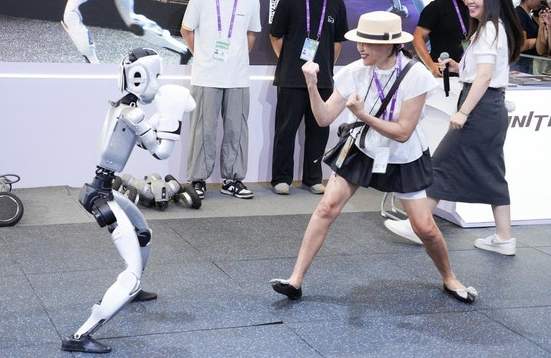
China has provided a clear roadmap for the development of China’s AI and accelerated its growth by releasing a series of new policies such as ‘Opinions on the in-depth implementation of AI+’ actions. Analysts say that continuous strengthening of basic research, focusing on developing core technologies such as basic software, and promoting the transformation of the scientific research paradigm centered on the AI field have innovated science and technology in each area and made a breakthrough.
The innovation and vitality unleashed here opened up a new track for the industry.
During the “14th Five-Year Plan,” the number of Chinese AI companies and the size of the industry continued to grow. Chinese-made foundation models such as DeepSeek and Alibaba’s Tuning Chen Wen are driving the innovation ecology of global open sources, while handset products such as AI phones are accelerating the spread. As science and technology and industrial innovation converge in depth, creating a new market space constantly amid a wide range of application scenarios.
In addition, as data elements are circulated, their potential is steadily being released.
China has abundant data resources, a complete industrial system, and is emitting strong growth engines by accumulating energy in the digital economy. Last year, the number of data companies in China exceeded 400,000 and the size of the data industry reached 5.86 trillion yuan. This is a whopping 117% increase compared to the end of the 13th Five-Year Plan (2016-2020).
Currently, China has fostered a total of 400 AI-grade small and medium-sized enterprises (SMEs) to specialize, refine, specialize, and re-emerge in the field. AI has become a key engine to nurture new productivity by taking root in a number of industries.
In the agricultural sector, the Chinese agricultural foundation model “Wanxiang Gengyun” is supporting spring and autumn farming by monitoring soil humidity and issuing weather forecasts based on more than 40 million agricultural expertise.
Looking at the field of people’s livelihoods, Shanghai Xiang AI restaurant offers more than 3,000 menus and is responsible for the “taste” of numerous homes by controlling taste and cooking volume through smart algorithms.
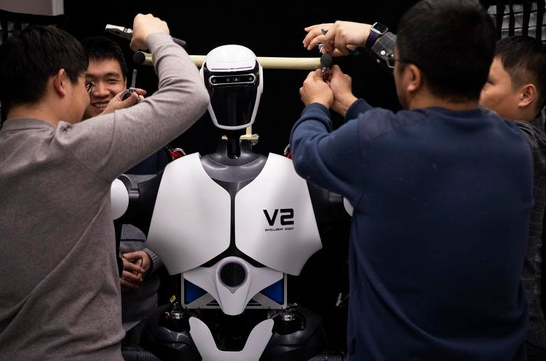
On the industrial front, Anhui Lingyang Industrial Internet Platform has launched an industrial foundation model 3.0, empowering small and medium-sized companies to transform their “research, production, supply, sales, service, and management” into digitalization. Since the implementation of the “14th Five-Year Plan,” 35,000 basic-level, 7,000 advanced-level and 230 desk-level smart factories have already been built in China.
In the future, China’s AI is expected to develop more stably and faster amid high-quality development based on patents and industrial superiority as favorable policy factors continue to emerge during the 15th Five-Year (2026-2030) Plan and the generational change of technology is accelerating. Looking at the field of people’s livelihoods, Shanghai Xiang AI restaurant offers more than 3,000 menus and is responsible for the “taste” of numerous homes by controlling taste and cooking volume through smart algorithms.
On the industrial front, Lingyang Industrial Internet platform has launched an industrial foundation model 3.0, empowering small and medium-sized companies to digitize their research, production, supply, sales, services, and management. Since the implementation of the “14th Five-Year Plan,” 35,000 basic-level, 7,000 advanced-level and 230 desk-level smart factories have already been built in China.
In the future, China’s AI is expected to develop more stably and faster amid high-quality development based on patents and industrial superiority as favorable policy factors continue to emerge during the 15th Five-Year (2026-2030) Plan and the generational change of technology is accelerating.
EJ SONG
US ASIA JOURNAL

