


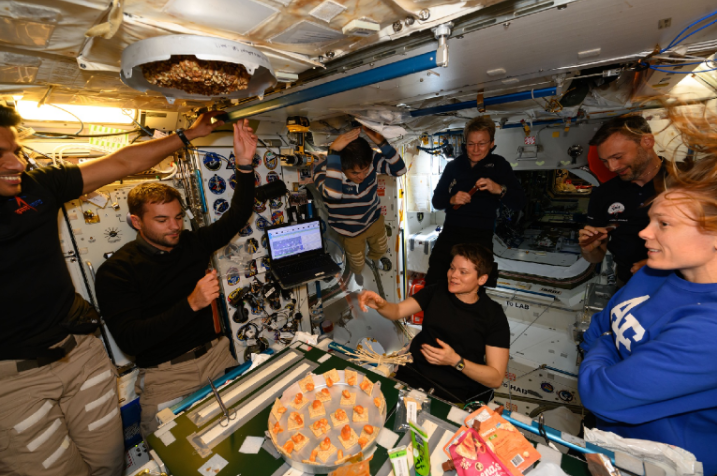
NASA recently introduced a photo of the “Uzusushi” taken by Korean-American astronaut Johnny Kim through its official Instagram account. The sushi in the photo was a simple dish of rice, tuna, or ham on top of square seaweed, and another menu was shrimp on cracker. The shrimp on the cracker is fixed with seasoning, and the sushi is maintained in its shape thanks to the surface tension caused by moisture, NASA explained.
“Most of the food astronauts eat should not be crumbled up into food that is transported from Earth for long-term preservation,” NASA said. “But that doesn’t mean their meals are boring.” Astronauts eat traditional dishes, special space pizzas made from tortillas, and finger foods that are easy to enjoy. The newly released “Spacefish” is also a part of the plan.
Space food began as puree in tubes or freeze-dried meals in the early days, but now the ISS has more than 200 menus. Korean food menus such as red pepper paste, bibimbap, and bulgogi, which were taken to space by Dr. Lee So-yeon, the first Korean astronaut, in 2008, are also examples.
In an environment without gravity, food crumbs or liquid droplets can enter the machine or block the respiratory tract, which is dangerous. For this reason, tortillas are used instead of bread, and liquid drinks are consumed in special pouches using straws. This is why NASA is emphasizing “non-crushing food.”
NASA is also conducting food research in preparation for long-term exploration. The company is continuing its experiments to grow vegetables such as peppers and lettuce for the moon and Mars mission, and it is expected that it will be able to develop a variety of menus with fresh ingredients grown directly in space in the future.
Internet users who heard the story responded wittily, such as “It’s Johnny Kim Jeongsik” and “It looks like a lunch box that my mother packed.”
JENNIFER KIM
US ASIA JOURNAL

