


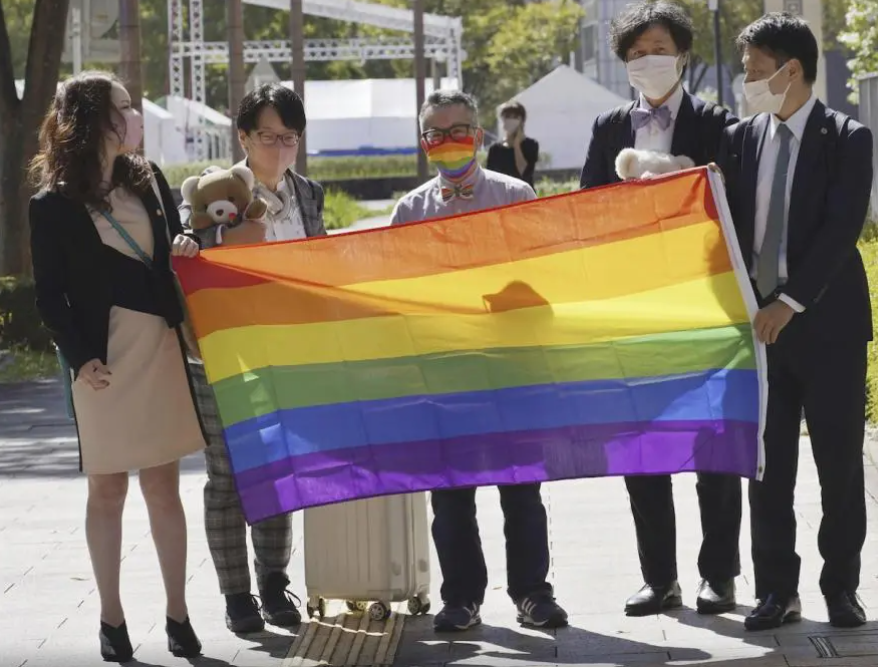
It is drawing attention in that the existing provisions of the law, which require physical changes such as surgery and hormone therapy to be enforced for gender change, violate the Constitution. According to Japan’s Nihon Keizai Shimbun on the 24th, the Sapporo Family Court on the 19th recognized the “gender change” of the applicant A with a gender identity disorder. A, who was born a biological woman but did not receive hormone treatment for health reasons and did not receive a mastectomy, allowed her to change sex to a man.
A failed to meet two of the five “gender change” requirements required by the Japanese legal system. In order to change the gender in Japan, one must be 18 years old or older, not married, have no underage children, have no reproductive function (meaning that the reproductive organs such as the uterus, ovaries and testicles should be surgically removed so that they cannot give birth or make children), and after the change, the genital part must have a gender-like appearance. Among them, A failed to achieve the requirements of “no reproductive function” and “look” because he could not receive hormone treatment due to asthma and allergies and could not resect his breast.

However, the Sapporo Family Court ruled that the existing conditions violate the Constitution, saying, “Medical knowledge has progressed since the enactment of the law, and requiring appearance requirements is not reasonably relevant.” In particular, while introducing the interpretation that “it takes into account confusion in public baths where the body is exposed,” he said, “Most people with gender identity disabilities tend to avoid using public baths themselves because they are resistant to showing their bodies to others due to a sense of incompatibility with their bodies. In fact, it is extremely unlikely that confusion will occur.” Existing interpretation of the law meant that there was a gap with reality. In Japan, judicial decisions have recently been made to respect LGBTQ rights. A case in point is that the Japanese Supreme Court, which is equivalent to the Korean Supreme Court, made a “constitutional” decision on the “reproduction function” part of the gender transition requirements in 2019, and in October 2023, more than four years later, the decision was made to be “unconstitutional.”
In the case, the claimant wanted to change the gender from male to female, but did not have genital resection, so he did not meet the requirements for “probative function” and “appearance.” The Supreme Court, which concluded that it was “unconstitutional” regarding the reproductive function requirements, returned the case to the Hiroshima High Court without any special judgment regarding the “appearance” requirements. And in July last year, the Hiroshima High Court allowed the gender change from male to female without sex change surgery, saying that there was “unconstitutional room.”
SALLY LEE
US ASIA JOURNAL

