


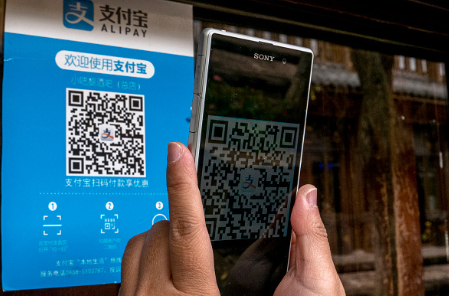
The direct goal is to expand the convenience of foreigners’ payments in China and Chinese people’s foreign payments. In the long run, it seems to be a strategy to spread the Chinese-style payment experience and use it as an infrastructure to support the internationalization of the yuan. Chinese economic media Caixin said on the 18th that Luh Lei, vice president of the People’s Bank of China, guided the Korea Payment and Settlement Association and China Union Pay to build a QR code integrated gateway and began piloting it at the end of July at the 14th China Payment and Settlement Forum on the 16th.
The pan-border QR code is an attempt to solve the problem of using overseas electronic wallets for the convenience of overseas visitors to pay in China, using Chinese electronic wallets for the convenience of Chinese overseas payments, and QR code payments that have become China’s standard payment method. China is the world’s largest QR code application market, accounting for more than 70 percent of global QR code payments.
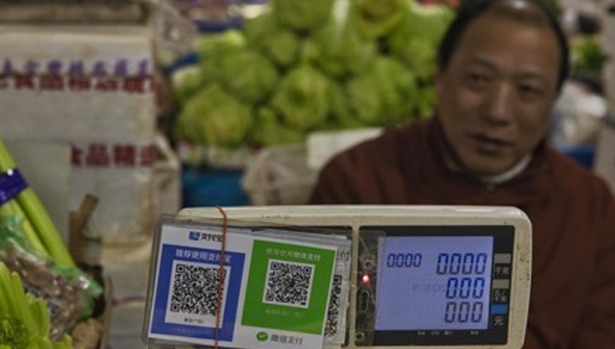
China has pushed for the spread of cross-border QR codes over the past two years, and last year’s transaction volume rose 30.4% year-on-year to 1.6264 trillion yuan, but as the number of participating organizations increased, standard discrepancies arose, and institutional cooperation routes were incompatible, limiting the rapid and stable spread of cross-border QR codes.
Chaixin said that the “Cross-Border QR Code Integration Gateway,” which Vice President Lu disclosed that he has started a pilot operation, is a way to solve this problem. In this regard, Vice President Lu said, “It is an important time for the Chinese payment industry to transition from a high-speed growth stage to a high-quality development stage,” adding, “One of the key solutions for this is the interlinked QR code payment.”
The cross-border QR code integrated gateway is a system that connects, coordinates, and interprets QR code payment systems in various countries so that qualified institutions can perform QR code payments. Chaixin said that the pilot participants in the integrated gateway are believed to be multiple institutions, including Alipay, WeChat Pay, Singapore, Malaysia, and Thailand.
As such, it seems to be a paving stone for the internationalization of the yuan and the expansion of global settlement influence by laying a “highway” for the convenience of cross-border payments. In this regard, Vice President Lu said, “In the future, we will further promote cross-border settlement interconnection to strengthen cooperation mechanisms between government, infrastructure, and market players and facilitate the flow of financial networks connecting China and the world.”
“The integrated gateway acts like a translator or scheduler,” said Dongximiao, a senior researcher at Chinese consumer finance company Zhao Lian. “In the long run, it will have a positive impact on expanding international settlements of the yuan and promoting trade and human exchanges between countries.”
JENNIFER KIM
US ASIA JOURNAL

