


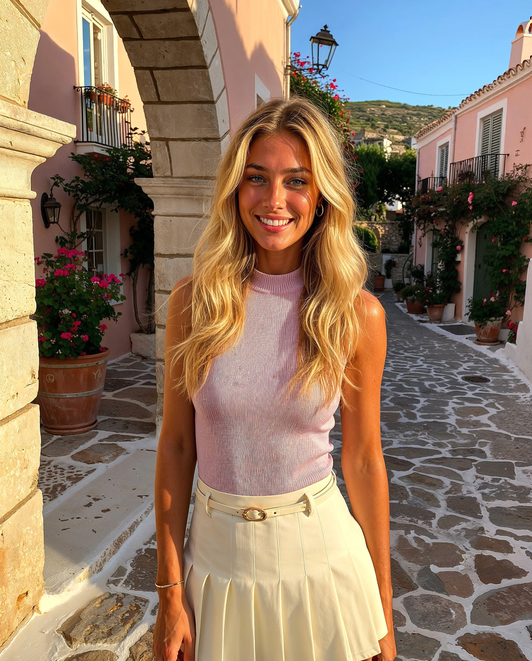
On the 1st, the Financial Times (FT) reported on a female college student influencer named Tinsley.
In an eight-second video she posted on TikTok, Tinsley shed tears that she failed to join the school club she wanted. Her followers posted supportive comments such as “Cheer up” and “Don’t give up” to Tinsley.
However, it turned out that Tinsley is a virtual influencer created by Olivia Moore, a partner of Silicon Valley venture capital group a16z. “It takes less than 10 minutes to create such an AI influencer account,” Moore said. “This could be the future of brand, marketing and entertainment.”
In fact, large global corporations are also actively using AI influencer. Fashion company H&M put an AI-made replica model in its advertisement, and Hugo Boss collaborated with AI influencer Ima, which has 500,000 followers. The FT estimates that the economy in this sector will exceed $250 billion as of 2023. From the brand’s point of view, it has the advantage of being able to market inexpensive and immediate influencer, and securing full control over them. “This is equalization, where even small-budget brands can provide sophisticated and large-scale content,” said Alexandro Boyka, policy director of media production startup Cynesia.
However, the FT said that traditional influencer and marketers are afraid that they will be replaced by AI. “This is a dangerous situation not only for models, but also for creators, hair, makeup, stylists, photographers, and more,” said Gabriela Halikas, a big-size clothing model and influencer.

There are also concerns about various side effects of the advent of such AI influencer. As such AI influencer are often difficult to distinguish from real people, the biggest problem is fraud in which AI is advertised or sponsored as if it were a human being. AI influencers may also make the beauty standard unrealistic. “AI is literally not real. It is a very concerning point for young people and women,” Halykas said.
Some point out that big tech companies such as Meta and TikTok will introduce AI production functions, and “AI Slop” will be realized, which is full of low-quality AI content. Slop, which means food waste, refers to low-quality content that AI prints in large quantities.
However, some argue that it is difficult for AI to completely replace human influencer. According to market research firm Twixie, the participation rate of actual influencer sponsored posts was 2.7 times higher than that of AI influencer. In addition, actual influencer’ average revenue per post was 78,777 dollars, far ahead of AI influencer’s 1,694 dollars.
SOPHIA KIM
US ASIA JOURNAL

