


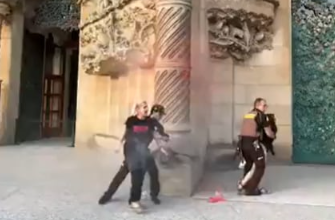
Environmentalists claiming “climate justice” sprayed paint on the Sagrada Familia in Spain, famous for its architect Gaudi’s masterpiece. The entire Western world is suffering from the so-called “eco-vandalism” that damages cultural heritage in the name of urging attention to climate change and environmental destruction. Echo-vandalism, which began in earnest in Western Europe, does not cover art works by masters, as well as famous buildings, historic sites, and ancient documents. Recently, similar crimes have been committed in the U.S. and Australia.
According to AFP, two activists from a group called “Future Plants” sprayed red and black paint on the bottom of the outer pillar of the Sagrada Familia on the 31st of last month. They were soon arrested by police, and footage of the group’s video was released on their social media. “Climate change has caused severe wildfires across Spain this summer,” they said. “Government action on climate change is insufficient.” The group held several similar protests in 2022, such as attaching adhesive hands to Goya’s masterpieces “The Unclothed Maha” and “The Unclothed Maha,” which are owned by the Prado Museum in Madrid, the capital of Spain. As they targeted Sagrada Familia, Spain’s leading attraction, Western countries point out that “the harm of eco-vandalism has gone too far.”
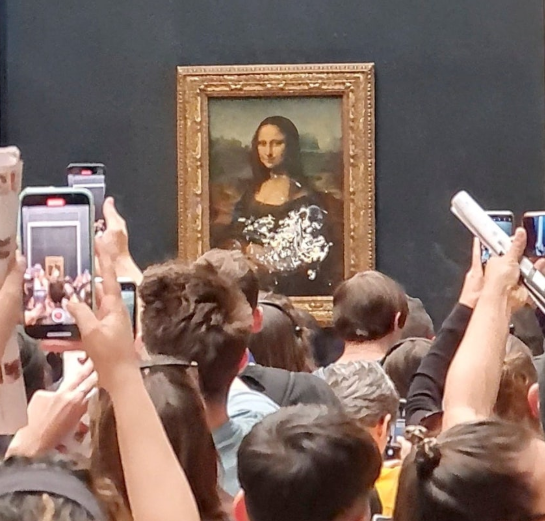
Eco-vandalism started in earnest in 2022. In the same year, a man threw a cake at the Mona Lisa, one of the Louvre Museum’s flagship collections in Paris. He said, “Think of the earth. Every artist has to think of the earth, and this is why I am terrorizing.” Although his artworks were not damaged thanks to protective glass, the scene where a world-class masterpiece was terrorized shocked. Similar crimes continued across Europe in the same year. A tomato soup was thrown at Gogh’s Sunflower at the National Gallery in London, and a mashed potato was thrown at Monet’s masterpiece “The haystack” on display at the Potsdam Barberini Museum in Germany. Environmentalists rubbed glued hands and hair on Vermeer’s painting “The Girl With a Pearl Earring” owned by the Hague-Mauritz-Hawis Art Museum in the Netherlands, and threw tomato sauce. Botticelli’s Primavera at the Uffizi Museum in Florence, Italy, and Picasso’s Massacre in Korea at the Museum of Art in Melbourne, Australia, suffered similar damage. Eco-vandalism spread outside of Europe.
Methods and targets have also been diversified. In 2023, an ink terrorist attack occurred in which a green dye was sprayed on the Venetian Grand Canal to turn water into an “green algae latte” or the fountain in Rome into black. Last year, an orange paint was sprayed on Stonehenge, an ancient British site. Red powder was thrown at the National Archives in Washington, D.C., where the original U.S. Constitution was displayed. Climate and environmental activists argue that eco-vandalism is an urgent act to publicize the seriousness of the climate crisis. They say that most important works and relics are protected by bulletproof glass, and throwing objects are virtually safe as they have little destructive power such as tomato soup or potatoes. They say that this is an effective strategy that can attract public attention by only causing symbolic damage to the artwork.
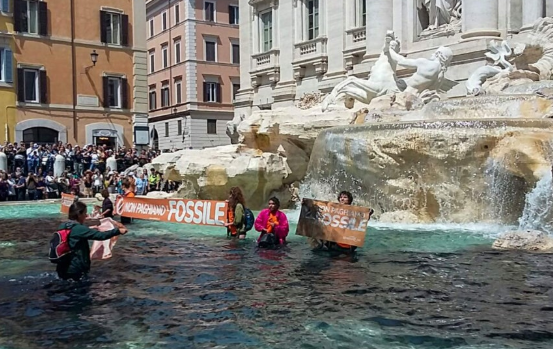
When Italian Prime Minister Jorja Meloni defined eco-vandalism as a “pure act of destruction” in 2022 and strongly criticized it, an environmental group named Ultima Generacione (last generation) said, “We are just calling out desperate warnings from citizens.” NBC News said, “Young activists in their teens and 20s are extremely worried about the future crisis that climate change will bring. The more they feel that the older generations and the government’s response is insufficient, the more they choose more aggressive tactics.” However, even if the purpose is justified, critics say that the behavior of eco-vandalism is not fundamentally different from terrorism by armed groups if they focus only on attracting attention by advocating violent means. Climate and environmental groups are protesting, saying, “We are branding peaceful protests as ‘terrorism’, ‘destruction’, and ‘extreme’ as violence.”
EJ SONG
US ASIA JOURNAL

