



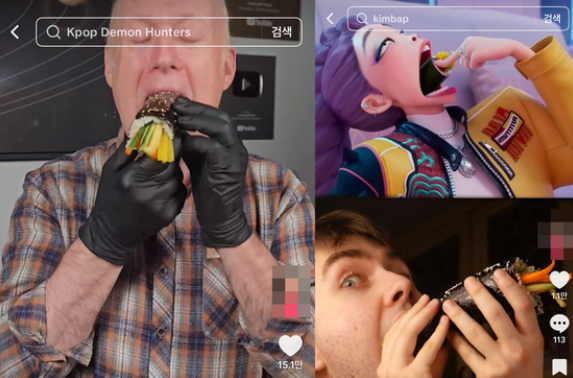
As the scene where the main character of K-pop Demon Hunters eats an entire row of kimbap drew attention, a “eating in one bite of kimbap” challenge also took place on social media.
As of the 30th, more than 180,000 hashtags of “gimbap” have been registered on Instagram, and more than 17,000 related videos have been posted on TikTok. In particular, a video of an overseas TikTok user biting a line of gimbap without cutting it, calling it “Kedeheon Rumi’s gimbap,” drew attention with 3.5 million views and 153,000 likes.
In addition, there are a number of contents that imitate the scene where Rumi in Kedeheon eats gimbap, cooks rice with rice, handles pickled radish, ham, cucumbers, rolls the gimbap, applies sesame oil, and sprinkles sesame seeds.
A video clip of a gimbap cooking posted by an Instagram international user has received well over 22 million views on Reels. The video had English comments such as “I tried gimbap for the first time about a week ago and I was addicted,” “Tell me how to make a recipe,” and “I want to try it too.” Earlier, “frozen gimbap” was popular in the U.S. in 2023. At that time, frozen vegetable kimbap was sold out within a few weeks of its release at the U.S. grocery store “Trader Joe’s,” and the video posted by Korean-American An Sera played a big role. The video of Ahn heating and tasting frozen kimbap products posted on TikTok quickly garnered 11 million views and now has 14.08 million cumulative views. Most of the 4,000 comments were about foreigners expressing curiosity about kimbap.
The Washington Post (WP), a leading U.S. magazine, published an article in March this year titled “How did Korean gimbap become a global sensation in comfort food?” The article introduced that the popularity of the ENA drama “Weird Lawyer Woo Young-woo” has brought the gimbap, which was the main character’s breakfast, to the attention of the world.
Such enthusiastic response has led to Kimbap’s exports. According to data from the Ministry of Agriculture, Food and Rural Affairs, exports of rice-processed foods such as frozen Kimbap and instant rice rose 38.4 percent year-on-year to 440 billion won last year. The growth rate of rice-processed foods in the U.S. was the steepest at 51.0 percent.
Pulmuone announced on the day that it became the first Korean food company to store its frozen gimbap at Sam’s Club in China in September last year, and its cumulative sales in China surpassed 2.5 million lines in 11 months. Cumulative sales amount to 53 million yuan.
The company explained that frozen gimbap is going viral as a “simple and luxurious Korean meal,” focusing on local social media. “We emphasized that it is Korean food by adding the phrase “K-STREET FOOD” on the wrapper,” a company source said. “The younger generation in China, who have experienced Korean culture through Korean dramas and K-pop, are the main consumers of frozen gimbap.”
SALLY LEE
US ASIA JOURNAL

