


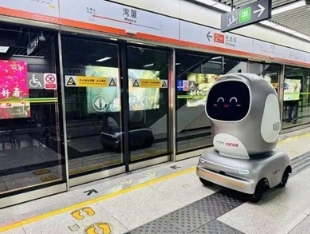
The world’s first robot to deliver by subway has appeared. An innovative technology that seems to have witnessed the future era has been implemented in Shenzhen, Guangdong Province, China. According to a report by local media in China on the 18th, the “subway delivery robot” made its first debut at Wansa Station on Shenzhen Subway Line 2 on the 14th. It successfully demonstrated an unmanned delivery system by combining artificial intelligence (AI)-based scheduling algorithm and robot technology at a time when passengers are less. On the first day of the robot delivery, as soon as the subway door opened, robots of the same appearance quickly entered the passenger car, lined up, and stopped stably. Passengers were curious about the robots that suddenly appeared, and took out their mobile phones all at once and immersed themselves in filming.
Inside these robots were filled with a variety of products favored by office workers, and through AI scheduling algorithms, they planned the optimal delivery route themselves and delivered them to convenience stores in subway stations. 7-Eleven managers who participated in the robot delivery test showed high satisfaction. Previously, store goods had to be transported to subway stations by ground transportation, and due to lack of parking space and overlapping rush hour, it took a lot of time and labor to enter the store. Simulations at more than 100 7-Eleven stores in Shenzhen subway stations show that 41 robots, combined with subway transport networks, will be able to meet the high-season logistics needs of all stores.
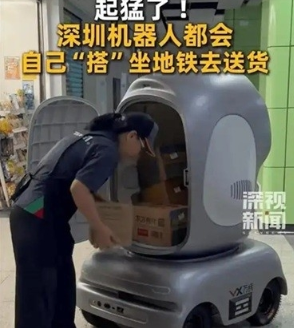
The core of the subway delivery robot is the smart scheduling system developed independently by Wanwei Logistics, a subsidiary of China’s Wanker Group. The system is designed to automatically plan an optimal route where multiple robots and multiple stores participate at the same time by comprehensively considering various factors such as the current status and location of daily orders, delivery time demands, and subway transport power of each store. The 360-degree omnidirectional laser mounted on the robot serves as an “eye” to help the robot find its way by precisely constructing an internal map of the station. The robot’s lower mechanical structure and control system are “skeletal and motor nerves,” which enable complete autonomous movement of elevators, platform movements, and subway rides. Currently, there are more than 300 stores in Shenzhen subway stations. When the robot is introduced in earnest in the future, it is expected that it will be able to utilize the idle transport power of the subway more efficiently and improve the logistics and delivery efficiency of stores. This will further enhance the operational convenience of the subway business district.
JENNIFER KIM
US ASIA JOURNAL

