


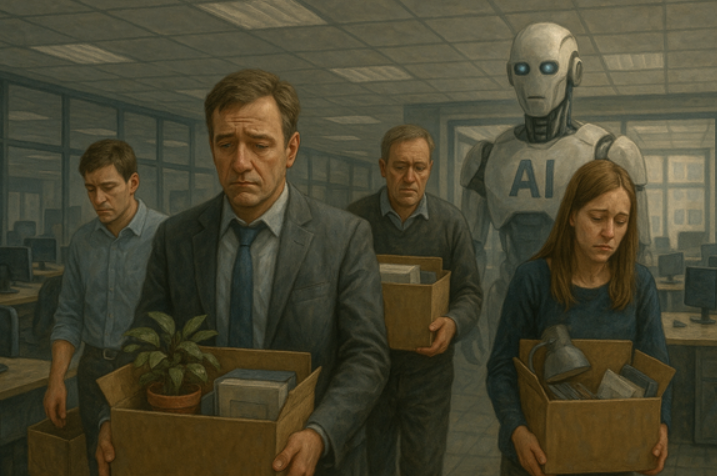
With the U.S. stock market at an all-time high recently and the economy booming, major companies are unusually cutting jobs. Although it is a reduction in manpower due to the introduction of artificial intelligence (AI), companies are hiding it, U.S. economic media CNBC reported on the 20th.
In an interview with the Wall Street Journal (WSJ) in May, IBM CEO Arvind Krishna said he fired 200 human resources employees and replaced them with AI chatbots, and reinvested elsewhere, increasing the total number of employees at the company. In an interview with CNBC in May, Sebastian Simiatkowski, CEO of Klarna, a fintech (financial + technology) company, said that he has reduced the number of employees by about 40 percent by investing in AI. These companies have unusually announced AI-induced job cuts, but experts believe that IBM and Klarna are not the only ones who are trying to reduce their workforce. Most companies point out that AI is hiding behind them for reasons such as reorganization, restructuring, and optimization.
“What we’re seeing now is an AI-led workforce reorganization that we just don’t publicly acknowledge,” Harvard University professor Christine Ying said. “Only a few companies say, ‘We replace people with AI,’ but that’s actually happening.”
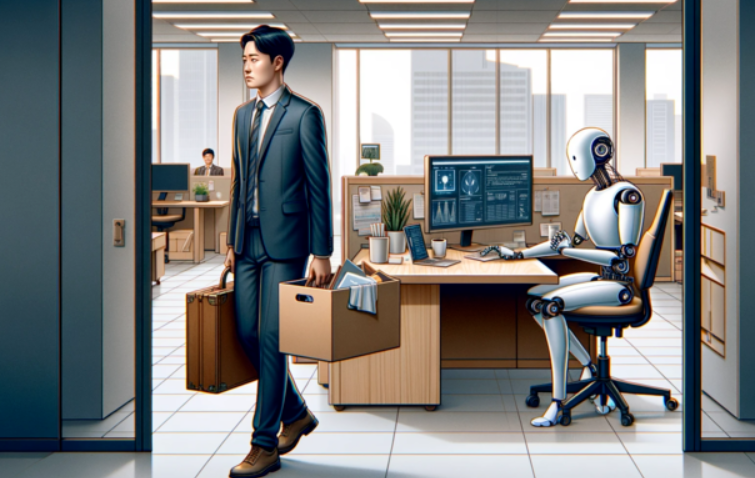
Candace Scarborough, director of cybersecurity and software engineering at Parsons, pointed out, “It is clear from the recent good performance that layoffs are not a response to financial difficulties. The timing of layoffs is award-winning with the introduction of large-scale AI systems.”
There are many reasons why companies hide AI-induced job cuts. “This silence is strategic,” Ying said. “To clarify that we have replaced it with AI can cause opposition from employees, the public, and even regulatory agencies. Blurring the word helps to manage the atmosphere.”
In fact, Duolingo announced a plan to gradually reduce the number of contract workers and introduce AI, but withdrew the plan in the face of backlash.
There is also risk aversion. This is because AI may not produce great results. Taylor Gocher, vice president of IT outsourcing company Connex Global, said, “AI is definitely behind the recent job cuts,” but added, “Companies invest heavily in automation, but sometimes they have to reverse that choice.” “If AI does not work properly, companies quietly rehire outsourcing or overseas workers,” he explained.
According to the World Economic Forum’s 2025 Future Jobs Report, 41 percent of global employers plan to cut jobs due to AI automation within the next five years. Dario Amodei, CEO of the AI company Ansropic, predicted that Generative AI such as Claude could replace half of the beginner’s office jobs.
Professor Ying pointed out that there will be a turning point for companies to become transparent about AI-induced employment changes, but by then it will be irreversible. “The scale of layoffs will be very large, and the only thing individuals can do is adapt,” he warned.
JENNIFER KIM
US ASIA JOURNAL

