


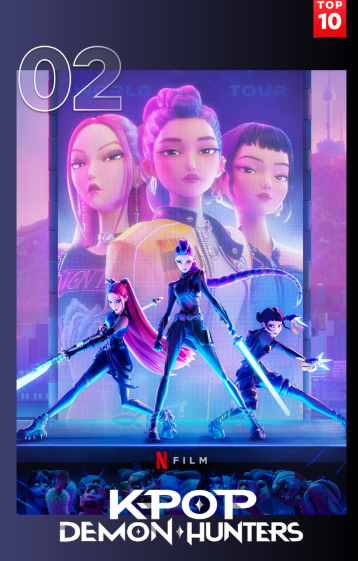
“The biggest name in K-pop is not BTS. It’s Netflix,” the WSJ reported on Tuesday, highlighting the global popularity of K-pop Demon Hunters and saying, “Virtual idol bands have reached a level that human idols have never achieved. Very surreal.”
The article was published online under the title ‘The biggest K-pop band to top the chart doesn’t really exist’.
The WSJ cited Kevin Woo, a former member of the group YouKies who sang the vocals of “Mystery,” a villain boy band, “The Lion Voice,” in the play. His monthly audience on Spotify was only 10,000, but it is currently around 20 million as Kedeheon made a splash.
Two of the songs featured on K-pop Demon Hunters topped Spotify’s most streamed songs. This is a record that no other K-pop group, including BTS and Blackpink, has achieved, according to the WSJ.
The media pointed out, “As virtual idols become more popular than real idols, those who dreamed of reinventing K-pop faced a harsh reality.” “In particular, this happened as the music industry as a whole was struggling with new participants such as artificial intelligence (AI), which is beyond the existing framework,” he said. Kevin Wu is said to have seen children dancing to Lion Boyz’s song while taking a break with a friend at a hotel swimming pool in Los Angeles (LA). His friend asked the children, “Do you really want to meet Lion Boyz?” and they screamed and asked for an autograph. Kevin Wu readily responded and wrote his name next to “mystery.”

“Playing a fictional character makes me feel very unrealistic,” he said. “People don’t recognize me as a Kevin Woo or K-pop artist.” “In a sense, it’s like reinventing my artistic talent,” he said, adding that he doesn’t mind if Lion Boyz’s activities shine more than his days as a group U-KISS, Broadway performances, and acting.
Professor Kim Seok-young, a K-pop researcher at the University of California, Los Angeles (UCLA), said, “The success of K-pop Demon Hunters shows that fans can communicate with non-human idols,” adding, “There is a high possibility that we will produce imitations in the future.” “This is a long-standing dream of K-pop companies,” he said. “There are idols here who don’t sleep, don’t get sick, and don’t get old.”
On the other hand, K-pop producer and composer Benny Cha said, “It is not necessary to exclude humans.” Having worked with AI singers, he said, “We cannot create the vulnerability, chemical reactions, and unpredictability that real artists show.”
SALLY LEE
US ASIA JOURNAL

