


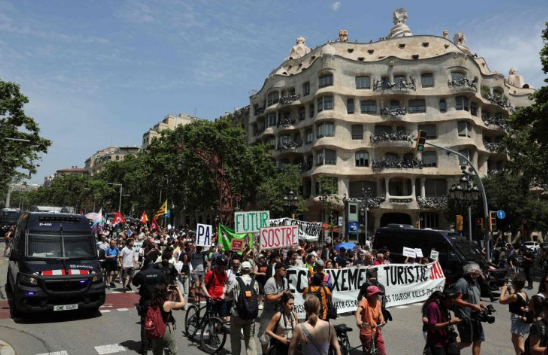
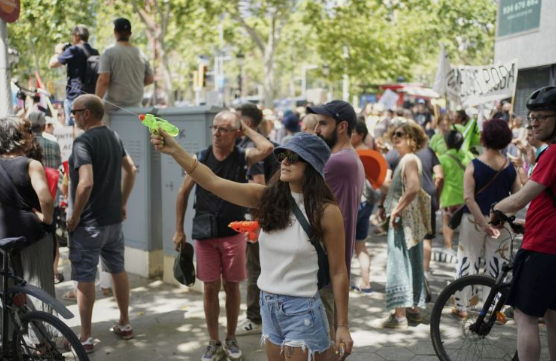
While global tourist cities are suffering from excessive tourists, residents’ complaints about “overtourism” have erupted in some tourist cities in Europe. In particular, they have held performance protests in which they shoot water guns at tourists, drag suitcases and cause noise, and the conflict between locals and tourists is in full swing. The New York Times (NYT) reported on the 15th that anti-tourism sentiment has once again risen since last summer’s water gun protest in Barcelona, Spain.
About 1,000 protesters marched along the Golden Mile, an upscale shopping district in downtown Seoul, holding signs with phrases such as “Tourists go home” and “Tourism is stepping away from us.” Some demonstrators even shot water guns at tourists passing by luxury brand stores. In front of the nearby hostel, physical altercations with employees and smoke bombs exploded. The protest was stopped by police near the Sagrada Familia Cathedral.

The New York Times analyzed that the protest was triggered by the Southern European Anti-Tourism Network workshop held in Barcelona in April. The protesters point out structural problems beyond just expressing emotions. It is argued that the economic structure dependent on the tourism industry has led to rising rents, housing shortages and environmental destruction. Juan Mars, a Barcelona citizen and restaurant worker who participated in the protest, criticized, “Most of the tourists are considered to be people who come to drink by renting houses that we can’t afford,” and “The problem is not tourism itself, but a tourism model woven around the real estate and hotel industries.”
In Spain, the tourism industry accounts for about 12% of GDP. The problem is that the increasing number of tourists and the quality of life felt by residents are inversely proportional. In particular, Barcelona has a population of only 1.6 million, and 26 million tourists visited the city last year. Protesters warned that unless the number of tourists is reduced, they will be repeatedly kicked out of the community. This phenomenon has occurred not only in Barcelona, but also in major tourist destinations such as Mallorca, Ibiza, Minorca, Malaga and Granada. In Mallorca, intense actions continued, such as stopping double-decker tour buses and setting off fireworks. “This tourism model only intensifies the housing crisis rather than economic prosperity,” said Pere Joan, a spokesperson for the Mayorkas regional group Less Tourism, More Life.
In addition to Spain, protesters in Genoa, Italy, held a “Soran March” in which they dragged suitcases and made noise, and in Lisbon, citizens held dolls depicting the adult image of the city center, occupying the new site of a five-star hotel. In Venice, a daily admission tax of 5-10 euros was introduced due to excessive tourism regulations, and there were also small protests over the recent conversion of hotel areas and public rental housing into tourist accommodation.
Among them, the number of foreign visitors across Europe has increased by about 5% year-on-year this year. As a result, Greece’s Santorini and Belgium’s Brugge plan to strengthen tourism taxes, while Barcelona plans to ban the operation of short-term rental apartments such as Airbnb by 2028. Some areas, including Ibiza, will restrict cruise ships from entering, and Mallorca recently announced that it will remove 1,600 beach chairs installed on the beach.
Meanwhile, as global tourist cities have been plagued by excessive travelers, authorities are working on solutions for sustainable tourism. According to Forbes, a U.S. economic magazine, countries around the world have recently introduced three solutions to overtourism: dispersing tourists, coexistence of residents and tourists, and inducing changes in attitudes of travelers.
JENNIFER KIM
US ASIA JOURNAL

