


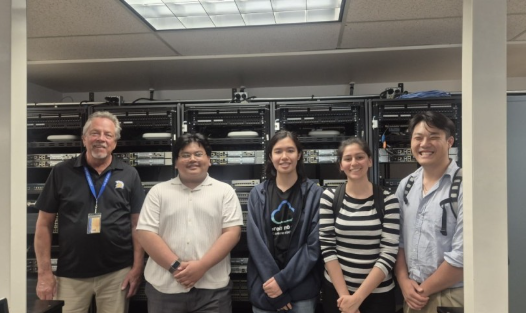
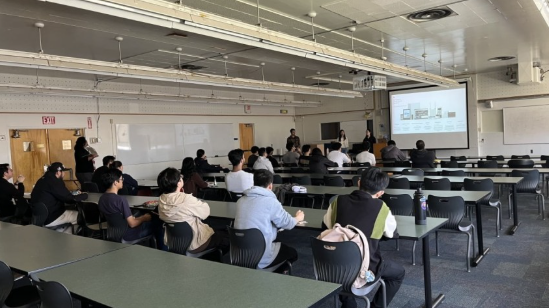
A computer system student I met at the University of San Jose (SJSU) campus in California said, “If you take this lecture, you will be given the opportunity to obtain cloud certification for Amazon Web Service (AWS), which will increase your job competitiveness.” The “Cloud Foundation” he listens to is an industry-academic cooperation lecture run by SJSU in partnership with AWS.
AWS has been providing its own cloud, latest curriculum, and lecture materials to SJSU for free since 2019 as part of an educational support program named ‘AWS Academy’. SJSU has included this lecture in the regular course so that all computer systems students can listen. In order to allow as many students as possible to take the course, the major has also been expanded. In fact, in this lecture, students majoring in business administration and computer engineering can also find it without difficulty. Industry-academic cooperation between big tech and universities in the United States is spreading in all directions. This is the result of the need (needs) of universities to expand students’ employment doors through practical training required by companies and companies to expand their pre-trained artificial intelligence (AI) and engineering talent pool to meet their technology needs. “Students who have completed AWS Academy work in the field, and unlike others, they do not need to receive additional work-related education for a year because they all have the skills required by companies,” said Richard Grotegut, a professor at SJSU who teaches cloud foundation. “The number of students taking the same lecture started from 200 six years ago and increased to 600 this semester due to word of mouth that the competitiveness of employment will inevitably increase.”
A case in point is the University of California (CSU), which includes SJSU. CSU, the largest public university system in the U.S., announced its AI transformation initiative in February in partnership with 10 companies including Google, Microsoft, Nvidia, OpenAI, and AWS. The key is to train AI talents by conducting practical AI training for all 460,000 students and 63,000 faculty members of 23 universities that make up the CSU, including SJSU. With the support of each company, students can use various AI tools such as ChatGPT for free. The CSU attracted companies by saying that it is an ideal test bed for them to test the universalization of AI education by focusing on the fact that it is composed of students from various races, classes, and regions.

Universities believe that industry-academia cooperation with big tech is very helpful in attracting students. It is revealed that it is advantageous for employment as students can learn the skills used in actual industrial sites, not theory. SJSU is working with Cisco as well as AWS throughout the curriculum and operation of the Department of Computer Systems. In addition to providing universities with the latest network equipment, Cisco also operates an apprenticeship program that allows them to combine academic and paid practical experience.
Fred Varez, head of SJSU’s mechanical engineering department, said, “The industry-academic cooperation lecture with AWS is an opportunity for students to experience the technologies used in actual industrial sites first,” adding, “It is very important for companies that will hire our students to know what technologies they actually use and what kind of talent they need.” He added, “A talent who can use AI well as a tool is a talent that both universities and companies want.” The Trump administration’s cuts in R&D budgets are paradoxically an opportunity for universities to get closer to companiesThe National Institutes of Health (NIH), which was considered one of the biggest beneficiaries of R&D subsidies at U.S. universities, spent 27 billion dollars in fiscal 2026, down 42.6 percent from the previous year. The National Science Foundation’s budget also decreased by 55.6 percent from 9 billion dollars to 4 billion dollars. According to a recent report released by the NSF, 55 percent of R&D funds in U.S. universities came from the federal government as of 2023. Companies accounted for only 6 percent of the total. However, as the NSF and NIH budgets, which were the two largest pillars, have been halved, universities and universities are turning their eyes to companies.
The same goes for companies that have penetrated such a gap. Local tech industry sources believe that joint research with universities can not only disperse risks (risk) in developing innovative technologies but also secure intellectual property rights (IP) such as patents and papers. The biggest incentive is that they can cultivate customized talents specializing in their own technologies. According to global online education platform Kosera, 94 percent of companies said universities should educate students about AI technologies. Seventy-five percent of companies also said that AI-related certificates are better than those with more experience.
“AI is the most transformative technology of our generation, but if we don’t learn to use this technology effectively and responsibly, it can be a social burden,” said Nigel Watson, director of Amazon Web Services (AWS). “Many companies say they will introduce AI, but they are not even able to think about where and how to cultivate talent.”
JULIE KIM
US ASIA JOURNAL

