


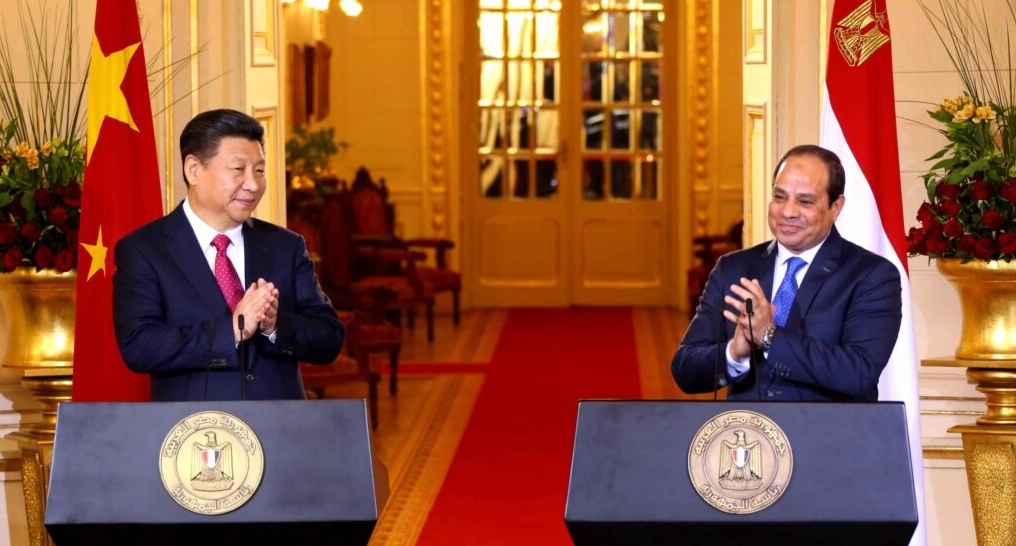
Chinese manufacturers are also moving production bases to Africa and Egypt due to the risk of a trade war between the U.S. and China.
According to Hong Kong’s South China Morning Post (SCMP) on the 15th, Chinese manufacturers have recently begun building factories in Egypt as an escape from U.S. tariffs.
This is different from the situation in which Chinese exporters moved their production bases to Southeast Asian countries during the first term of U.S. President Donald Trump, who imposed tariffs on China earlier.
This is because Southeast Asian countries were also included in the mutual tariffs announced by President Trump in April.
Huang Ping, a Chinese man who runs five motorcycle parts assembly plants outside Cairo, Egypt, has witnessed a sharp increase in Chinese investment in recent months.
He moved his factory from China to Cairo seven years ago in consideration of his access to emerging African markets.
“A delegation of Chinese companies visits Cairo almost every day these days,” Huang Ping said. “There are times when not only businessmen but also Chinese government officials come together.”
Many of those who recently moved to Cairo are businessmen who have operated factories in Southeast Asia.
“More than half of the companies I meet have existing factories in Cambodia, Thailand, Myanmar and Laos,” Huang Ping said. “They are choosing Egypt as their second option.”
Stability is cited as the first reason why Egypt has recently attracted attention among Chinese manufacturers.
“Most African countries are not always safe, and South America is more confused,” Huang Ping said. “Egypt is relatively stable, the government is friendly, and there is no anti-Asian sentiment.”
Egypt’s low wages are also attractive to Chinese manufacturers.
Egyptian factory workers’ wages range from $100 to $150 per month, less than half of the wages paid locally by Southeast Asian manufacturers.
Because of this cost competitiveness, the Egyptian textile industry is booming.
According to the Egyptian Clothing Export Committee, Egypt’s clothing exports from January to April this year exceeded $1 billion, up 22% from the same period last year.
The growth of the textile industry is attracting foreign investors, including Chinese companies.
The storage caddy industry, a well-known Chinese textile company, is a prime example of investing $100 million to build a factory in Egypt and enter the local market. The factory is expected to create 4,500 jobs in the future.
According to the SCMP, there are also many Chinese textile manufacturers who want to “export” to the United States through Egypt.
Egypt’s balanced foreign policy is also one of the reasons for attracting Chinese manufacturers.
Unlike other countries, Egypt has a relatively balanced trade while maintaining good relations with the United States, said Ding Yong, chairman of the Alexandria Chinese Chamber of Commerce in Egypt.
“For many of China’s exporters, Egypt is becoming a lifeline in an increasingly complex global trade environment,” he added.
However, as Chinese manufacturers flock to Egypt, factory rents in major economic zones have more than doubled in the past six months, and there are also side effects that small and medium-sized companies that are behind Chinese conglomerates are struggling.
Jiaxiang Sheng, who has been operating a small home appliance company in Egypt since 2017, said, “Chinese conglomerates such as Media and Haier have entered Egypt. We are forced to lower prices and endure.”
He said his company’s profits had halved compared to two years ago, adding that “companies are hitting prices in Egypt due to overproduction in China.”
SAM KIM
US ASIA JOURNAL

