


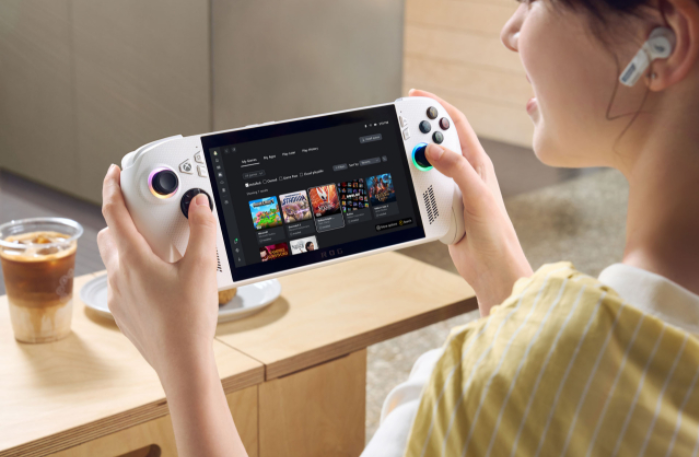
The strategy is to miniaturize existing Xboxes and cover PC gaming with Windows. With Nintendo releasing Switch 2, a portable and residential game console, Microsoft is moving backwards from a stand-up to a portable one. Microsoft announced at an online showcase on Tuesday that it will develop “Log Xbox Ally X” with ASUS in Taiwan and launch the product by the end of this year. Microsoft did not disclose the specific price and release date of the product, but it is said to be equipped with a seven-inch screen with a dedicated low-power AMD Ryzen chipset.
Its internal design is more of a portable computer than a game console. Windows is also installed to enable users to play PC games other than Xbox games. Another factor that distinguishes them is the installation of Copilot for Gaming, an artificial intelligence (AI). Microsoft’s strategy to combine the advantages of Xbox and Windows was embodied earlier this year. Jason Beaumont, vice president of experience at Xbox, said, “Workers who have been working on Xbox operating system (OS) for more than 20 years have combined with Windows to optimize them for form factors.”
The announcement of Microsoft’s portable game console seems to be aimed at Nintendo Switch 2, which was launched globally last week. The strategy is quite the opposite. The Switch series was a box office success thanks to the use of portable and portable devices as well as Nintendo’s exclusive game offering. Microsoft, on the other hand, used the portable Xbox as a weapon while maintaining openness to external games. The company is committed to targeting the rapidly growing global portable game console market. Business Research Insights, a market research firm, predicts that the related market will grow from 14.9 billion dollars last year to 28.1 billion dollars in 2032.
SALLY LEE
US ASIA JOURNAL

