


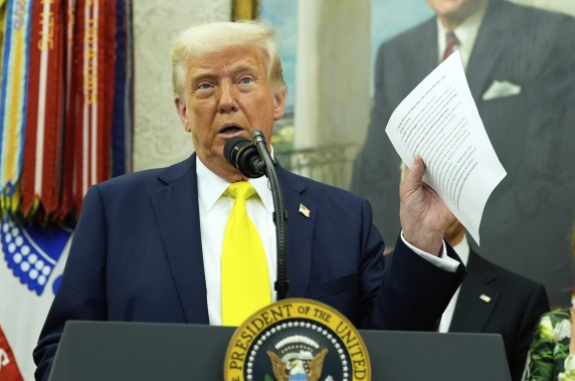
Donald Trump’s second administration, which celebrated its 100th day in office, brought up the “gag” that was bitten by the media during the first term.
On the 25th, U.S. Attorney General Pam Bondi said she has decided to search through reporters’ communication records to find out who provided information to media companies when reporting sensitive information.
Earlier, at the time of Trump’s first term, the U.S. Department of Justice attempted to search for informants in the government by searching phone records and e-mail records of reporters belonging to the WP, CNN, and the New York Times (NYT).
The investigation into the informant, which began at this time, continued until 2022, when Joe Biden was in power, and then Attorney General Merrick Garland ordered federal prosecutors not to conduct this kind of investigation.
According to U.S. media, Bondi issued an official letter containing the policy change policy, citing the case of “government information leakage” that occurred during the Trump administration.
However, he said he supports an “independent and free press” and added that reporters’ search for communication records will be used as a last resort after trying all other investigation techniques.
He also said he would seek ministerial approval to interrogate or arrest journalists about leaked information reports.
Secretary Bondi stressed that the Trump administration supports freedom of speech, saying, “Some members of the news media have no independence.”
“The Department of Justice will not tolerate the disclosure of unauthorized information that undermines President Trump’s policies, damages government agencies, and harms the American people,” he added.
The media objected to this policy.
Matt Murray, editor-in-chief of the Washington Post (WP), said in a statement, “The First Amendment (the United States that defines freedom of speech) plays a central role in our democracy and is a guaranteed constitutional right for all Americans.”
He then criticized the minister’s policy, saying, “The government’s attempt to summon reporters and search their communication records threatens these constitutional rights necessary for an independent media.”
As in the first term, President Trump called the established media the “enemy of the people” and also intensified his oppression of the media.
The Associated Press has restricted AP reporters’ access to the White House because it did not change the Gulf of Mexico to the United States in a style book used as a reporting guide.
It also blocked AP reporters from attending the White House event in defiance of a court order to lift restrictions on coverage against the AP.
On the other hand, it has allowed far-right YouTubers to enter and brief the White House.
Critics point out that Trump’s second term, which is only 100 days old, is putting the core principles of the rule of law and democracy to the test.
JENNIFER KIM
US ASIA JOURNAL

