


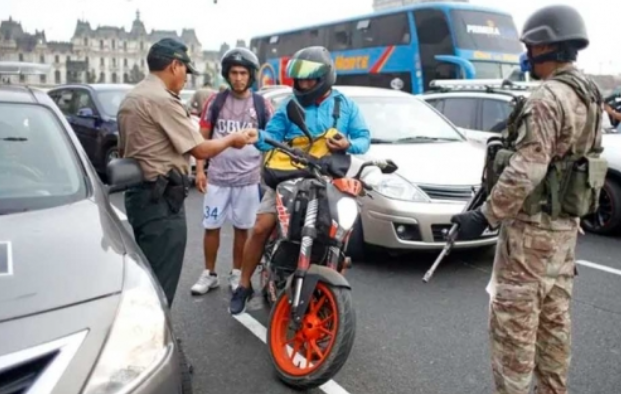
Attention is focusing on whether the two-person motorcycle ban, which was temporarily issued in Peru, South America, will be converted into a permanent measure.
Local media reported on the 20th that “a bill has been proposed to permanently ban two-person rides of motorcycles.” Representative Ilda Portero (People’s Action Party), who proposed the bill as a representative, said, “There is a high public opinion that two-person rides of motorcycles should be banned for security and safety,” adding, “The law is expected to be enacted without difficulty because there are many lawmakers who support it.”
Peru has extended a state of emergency in the Lima metropolitan area and the port city of Cayao by 30 days due to a surge in violent crimes. These regions are the political and economic centers of Peru, with a population of up to 10 million. In a state of emergency, where a state of emergency is invoked, the military is deployed to the streets to jointly manage security and security with the police.
The Peruvian government extended the state of emergency and banned two people from riding motorcycles until March 17. If someone is caught driving with a person in the back of a motorcycle, the motorcycle will be seized and fined.
The ban on two motorcycles was imposed because crimes using motorcycles are on the rise. Residents’ complaints grew as the two-member emphasis, who shared their roles by driving and snatching, appeared everywhere.
Carla, a resident who was recently snatched a bag on the street, said, “I hugged my bag so it wouldn’t be taken away, but I was even dragged by a motorcycle,” adding, “Fortunately, I wasn’t seriously injured, but I was so traumatized that I became reluctant to go out afterward.”
Many people use motorcycles for violent crimes such as contract murder. They are more mobile than automobiles and are easier to beat even if the police catch up. “These days, gangs mainly use motorcycles,” a police official said. “As organized crime increases, motorcycles are the subject of caution.”
The Peruvian government banned motorcycles from boarding two-seater based on reports from police, but there were many loopholes as the government hurriedly prepared the policy. In particular, inquiries from parents who use motorcycles for their children’s commute to and from school caught on. When inquiries flooded in, the police said they would flexibly apply the ban, adding, “If it’s a motorcycle that has taken students during school hours, we’ll consider it an exception.” However, even in this case, identification is essential, the police said, and asked them to bring their identification.
EJ SONG
US ASIA JOURNAL

