


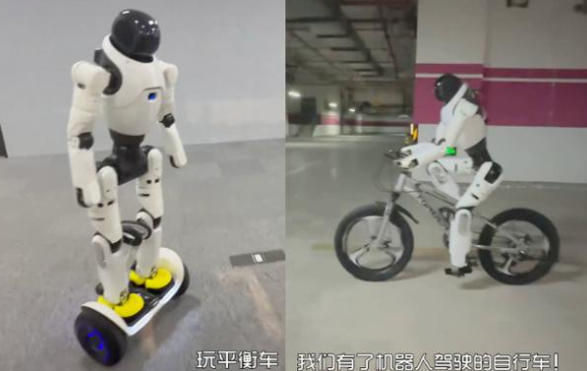
A new humanoid robot that can not only move naturally like a human such as walking, running, and dancing, but also interact with humans immediately through artificial intelligence (AI) has been unveiled in China. China is also speeding up its efforts to target the elderly care market with robots that combine AI (accident) and humanoid (motion) technologies.
According to China’s state-run media Global Times on the 12th, Shanghai’s humanoid manufacturer AgiBot unveiled the latest humanoid robot “Lynx X2,” which moves similarly to humans. Founder and Chief Technology Officer (CTO) of the company, Feng Zhihui, appeared in a promotional video and explained, “This robot, 1.3 meters tall and 33.8 kilograms in weight, shows excellent sports ability, such as riding a scooter and climbing on a hoverboard to balance it.”
It also has a complex interaction function that enables users to communicate with humans. Using the MLLM, robots analyze human language and emotions and provide corresponding responses. They can also quickly read and understand explanations on medicines. “Lynx X2 mimics human breathing rhythm, shows curiosity and attention, and can communicate with humans through subtle body movements and gestures,” the newspaper said.
For example, when CTO Feng asks for advice at 5 a.m., “Which one should I drink, milk or juice?” he suggests, “Drink milk that helps you sleep.” With the ability to make comprehensive judgments that take into account various situations, Lynsey X2 can act as a security guard, cleaner, or care for the elderly in the education and medical fields, the company explained.
In fact, China is rushing to enter the global market, believing that humanoid robots will become the main body of the future elderly care service industry. Recently, according to media such as China Central Broadcasting (CCTV), the International Electrical Technology Commission (IEC) announced an international standard (IEC 63310) for elderly care robots led by China. China has already taken the lead in the global market by creating a unified standard for the design, production, testing, and certification of elderly care robots.
The commercialization of elderly care robots is still in its infancy. However, the aging population, which is threatening China’s competitiveness, is accelerating the market’s growth. According to data from China’s National Bureau of Statistics, the number of senior citizens aged 60 or older in China is expected to exceed 400 million by 2035. This means that the demand for various elderly care services ranging from health care to nursing and companionship will increase, and elderly care robots are urgently needed to solve the problem of senior citizens in China. The Korea Trade-Investment Promotion Agency (KOTRA) predicted, “China’s elderly care robot market will continue to grow at an average rate of 15% over the next five years, and the market size will reach 15.9 billion yuan in 2029.
SALLY LEE
US ASIA JOURNAL

