


BEIJING — For U.S.-based global direct sales giant Amway, East Asia stands as a critical region housing the company’s top three markets — China, South Korea and Japan.
Though the popular conception is that China, backed by a massive consumer base, is the most important market for Amway, Korea in fact stands as the company’s top-valued market, according to Amway executive Sam Rehnborg, president of the Nutrilite Health Institute.
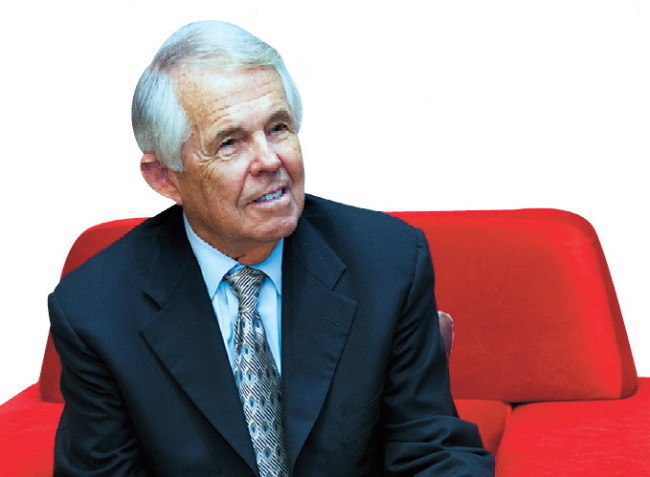 |
| Nutrilite Health Institute president Sam Rehnborg (Amway Korea) |
“Our No.1 market is Korea. Sometimes when (people) ask where our biggest market is, they say ‘is it China?’ (To that) I say no, it’s Korea,” Rehnborg said in a media conference at the end of the 2015 China & Korea Joint Phytonutrient Symposium in Beijing on Sunday.
“Amway worldwide sales are a little over $10 billion. If every country had the same market penetration that Korea has, our worldwide sales would be $44 billion,” Rehnborg said.
As Amway’s global sales reached $10.8 billion in 2014, Amway Korea racked up roughly 1.23 trillion won ($1.12 billion) in profits — 42 percent of which came from sales of Nutrilite products.
At the heart of Amway Korea’s unparalleled local success is its standout ability to extensively utilize what the Amway executive called “social marketing” — spreading awareness about a company’s product via personal networks.
Amway’s business model deviates from typical consumer marketing practices, as individuals, known as “Amway Business Owners,” personally introduce the company products to people around them and information about products spreads by word-of-mouth. Sales take place directly between an AMO and a consumer.
The president noted that Nutrilite’s core challenge is to convince consumers that its products have tangible and proven benefits to health.
“Seeing somebody that they know and believe use that product — that is (the essence of) what social marketing is. … And Korea has truly grasped the power of this method,” Rehnborg said.
Equally important to Amway for successful product marketing is the development of high-quality, certified products grown and manufactured under strict quality assurance measures — an area which Nutrilite strives to focus on more than any other aspect of its business.
“The only way that people will use our products is if they think it is the best product (available in the market),” the Nutrilite president said, emphasizing that “the products are not made based on price but to the highest quality.”
Mindful of growing consumer concerns regarding the benefits, safety and purity of health goods, Nutrilite, since its foundation in 1959, has established multiple mechanisms to systematically monitor and ensure the efficacy and safety of its products.
Under the principle of tracing its whole production process from “seed to supplement,” Nutrilite runs its own certification program known as NutriCert to ensure that all of the farms supplying botanical materials to its headquarters adhere to Nutrilite’s strict organic principles and standards, performing more than 500,000 quality checks every year.
In the case of Amway Korea, more than 30 R&D staff run quality assurance control tests while a separate team ensures that Nutrilite formulas meet all local regulations governing health products.
Nutrilite also has 150 scientists — with more than 50 advanced degrees and coming from 47 different technical backgrounds — who focus on phytonutrient research and new product development.
In a rare move for a health company, Nutrilite conducted a study in 2014 utilizing human double-blind placebo clinicals to prove that its best-selling product “Double-X” has traceable health benefits including DNA protection. A similar study was recently conducted in Korea, exclusively for Korean consumers.
“The products have to be the purest they can be made. And they have to be efficacious and produced the same way each and every time,” said Rehnborg. “We try to control the process from the beginning to the end … and that is the key difference between Nutrilite and other companies.”
By Sohn Ji-young (jys@heraldcorp.com)

