


The BBC reported on the 17th (local time) that “the number of young people complaining of hearing impairments has increased rapidly recently,” adding, “Experts cited ‘noise cancellation’, a major function built into earphones, as one of the causes.”
Media outlets introduced the case of Sophie, a 25-year-old woman from London. Having been raised in a quiet rural village in the U.K., Sophie felt abnormalities in her hearing after moving to London several years ago as a university student.
It was difficult to find the direction of the sound even after hearing a specific sound, and it was also difficult to take classes in the classroom. It took a lot of effort to understand the lecture as all the words sounded like rambling words. Even in everyday life, most of the sound was felt as noise, which made it difficult.
After a thorough examination at the hospital, he was diagnosed with hearing information processing disorder (APD), which had no hearing problems but had difficulty processing sounds and speech in the brain
Hearing information processing disorder, also called central hearing information processing disorder (CAPD), refers to a condition in which the brain cannot interpret this sound information correctly even though the sound is normally detected in the ear.
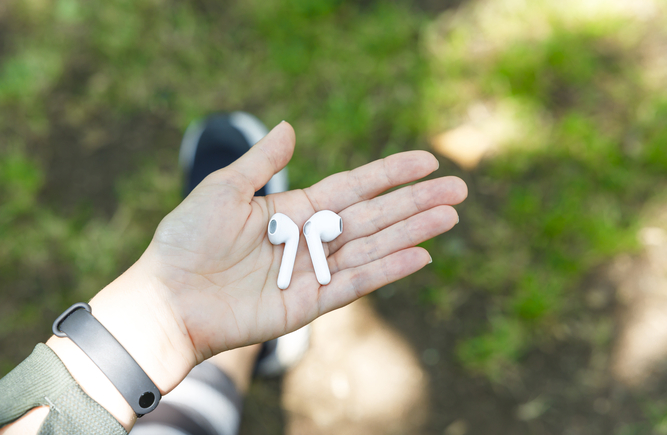
Experts pointed out that hearing information processing disorders are increasing among young people, which may be due to wireless earphones equipped with noise cancellation, a function that blocks ambient noise.
The noise cancellation function of earphones such as AirPods and Galaxy Buds has the advantage of helping ear health by blocking ambient sound while listening to music to prevent high frequency or loud sound from damaging the ears. However, some pointed out that there is a possibility that the brain may “forget” filtering noise by blocking daily sounds like the sound of a car horn.
Claire Benton, vice president of the British Auditory Society, explained, “The noise cancelling function creates a ‘false’ environment where the brain does not have to try to filter out noise by only listening to what it wants to hear.”
“The complex and high level of ‘listening ability’ of the brain is not developed until the late teens, but if you are in a false environment using noise canceling earphones or headphones until the late teens, the development of the ability to process speech and noise may be delayed,” he said.
Renee Almeida, clinical director of audiology at Imperial College Healthcare NHS Trust, explained, “There is a clear difference between hearing and listening. Noise cancelling can degrade listening.”
Some predicted that the number of people complaining of hearing information processing disorders will increase in the future.
Dr. Angela Alexander, a British hearing expert, said, “The demand for tests at hearing information processing clinics for children under the age of 16 has increased significantly. We need to study more about the impact of noise cancelling earphones on children’s hearing processing ability.”
He then recommended wearing earphones or headphones that do not completely cover the ears, saying, “To improve the problems with the brain’s listening function, it is better to reduce the time spent using earphones and use the ‘peripheral sound’ mode to hear external noise.”
JULIE KIM
US ASIA JOURNAL

