


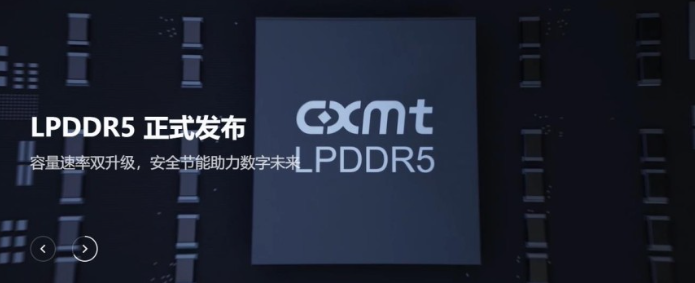
According to foreign media, Changsin Memory Technology (CXMT), a Chinese memory semiconductor company, is threatening Korean companies such as Samsung Electronics and SK Hynix by rapidly increasing its market share.
Citing data from Chinese consulting firm Chenzhan, the Financial Times (FT) reported on the 10th (local time) that the CXMT share in the $90 billion DRAM market was close to zero in 2020 but increased to 5% last year.
The DRAM market has been dominated by Samsung Electronics, SK Hynix, and Micron in the U.S., and these three companies accounted for 96% of sales in 2023.
Chung Chang-won, co-chairman of Nomura Asia Research, said in an interview with FT, “With the rise of CXMT, Korean semiconductor companies are facing a new reality of overflowing Chinese products in the low-cost market. This is not a technological advantage, but a matter of volume, and Samsung has been particularly hit by oversupply and falling semiconductor prices.”
CXMT had little DRAM production capacity in 2016 at the time of its establishment, but it began mass-producing DDR4, the latest DRAM product at the time, under investment from large Chinese companies such as Alibaba and the Chinese government in 2019.
According to consulting firm Semi-Analysis, CXMT also started mass production of DDR5, which is currently the latest in terms of standards, last year.
Nomura said CXMT is also aggressively increasing DDR4 production, and explained that wafer production capacity has increased from 70,000 units per month in 2022 to 200,000 units per month as of the end of last year. This is 15% of the global DRAM market.
FT pointed out that Samsung Electronics and SK Hynix’s profit margins are decreasing as old DRAM prices fall due to China’s offensive on supplies, and the two companies are eventually reducing their share of the low-cost market. Dan Hutchison, vice chairman of research firm Tech Insights, said that CXMT’s market share is still relatively small and the Chinese market share is large, but he believes that it is creating a “snowball effect” with rapid growth.
“The larger the market share, the higher the output and the higher the yield. The cost is lower and the market share is higher again,” he said. “This is exactly how Korea drove Japan out of the memory sector in the 1980s and 1990s, and now similar things are starting to happen to Korea.”
Chinese consulting firm Chen Zhan also predicted that CXMT’s DRAM market growth will quickly “grow like a snowball.”
CXMT is also focusing on the high-bandwidth memory (HBM) sector used in the AI field, while Chinese start-up DeepSeek has shocked U.S. big tech companies, which are pouring astronomical investments into artificial intelligence (AI) models with cost-effectiveness.
A source said CXMT is building a 280,000㎡ plant with HBM2 (2nd generation HBM) production capacity in China, but CXMT did not disclose its position on FT’s request for comment.
SK Hynix plans to start supplying HBM4 products in the sixth generation during the second half of this year. Samsung Electronics plans to supply HBM3E-enhanced products in the fifth generation to major customers from the end of the first quarter, while HBM4 aims to mass-produce HBM4 in the second half of this year.
Some observers say that CXMT’s expansion of HBM2’s production capacity will be a burden to Samsung Electronics.
Vice Chairman Hutchison said, “Samsung Electronics is caught in a nutcracker that is under pressure from SK Hynix, Micron in the high-priced product market, and CXMT in the low-priced product market.”
Some point out that CXMT is taking advantage of loopholes in U.S. export regulations, the FT added.
EJ SONG
US ASIA JOURNAL

