


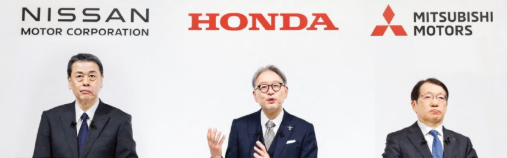
Nissan, Japan’s third-largest automaker, has decided to stop discussing management integration with Honda, the second-largest, by August 2026, the Nihon Keizai Shimbun reported on the 5th.
In the Japanese business community, analysts say that the two companies have virtually gone through the impossible process in less than two months since they started consulting on integration. The two companies will hold a board meeting soon to discuss the suspension of integrated consultations and make a final decision.
Initially, Honda and Nissan agreed to pursue management integration in a way that would be incorporated into subsidiaries under the holding company to be established in August 2026. However, contrary to the initial agreement, Honda sought to use Nissan as its subsidiary, and the discussion was halted due to Nissan’s strong opposition.
Honda said Nissan’s restructuring plan is being delayed and insisted that Nissan should come up with an intensive restructuring plan as a condition for the integration. In November last year, Nissan announced a plan to cut 9,000 jobs globally and hundreds in Japan, but Honda judged that this was not enough. However, there was a strong opposition to the restructuring within Nissan. U.S. President Donald Trump, who values domestic employment, said he could protest the restructuring of U.S. workplaces, and said late last month that he plans to adjust production instead of reducing manpower.
On top of that, the two companies disagreed over the ratio of the holding company’s consolidation, and the discussion on integration has been creaking from the beginning. The two companies tried to announce specific integration procedures at the end of last month, but the announcement was postponed to the middle of this month due to sluggish discussions.
Honda also said it needs to take control of Nissan in order to rebuild the country’s sluggish performance. Honda suggested Nissan to turn itself into a subsidiary rather than a one-on-one integration under the holding company. However, Nissan, which wanted to integrate the two companies equally, raised voices of opposition. In the process, a Nissan official said, “It is almost impossible to create conditions to persuade the two companies’ shareholders,” hinting that it would be difficult to further discuss the merger.
If Nissan and Honda succeeded in the merger, they would overtake Hyundai Motor Group to rank third in the world after Toyota and Volkswagen, drawing keen attention from the global auto industry. Some analysts say that Japanese companies have begun to grow their size through joint ventures in the wake of China’s electric vehicles’ massive airstrikes on the global market.
However, as discussions on integration have gone nowhere, it has become difficult to predict future changes in the global automobile industry. At the time of the announcement, the two companies said, “Device industries such as batteries and motors can lower costs as they grow in size. Cooperation is essential for competition of scale,” but the suspension of negotiations has made it difficult for both companies to strengthen their competitiveness.
Honda shares closed 8.19 percent higher in the Japanese stock market after the news of the merger was reported. Nissan, on the other hand, fell 4.87 percent and announced that it would stop trading about 10 minutes before the market closed.
SAM KIM
US ASIA JOURNAL

