


President Park Geun-hye will mark the start of her third year in office Wednesday overshadowed by political scandals, raging tax disputes and little progress on her pet policies of forging trust with North Korea and kicking off a “creative economy.”
Analysts say that, already beset by talk of lame duck status, Park must focus on making her policies a reality this year.
But contradictory tax policies and debates over constitutional reforms threaten to derail Park’s proposed economic restructuring reforms.
Many of Park’s initiatives were initially welcomed by the public. Her catchphrase during the 2012 presidential race, “welfare without taxation,” received particular applause. Support for her proposed reform of the national pension for retired civil servants has also been high.
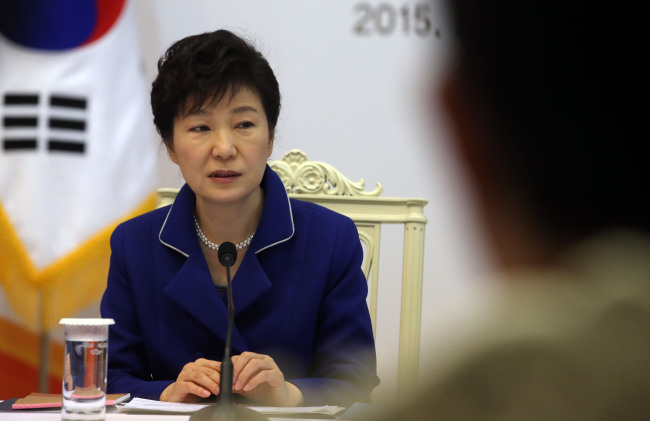 |
| President Park Geun-hye (Yonhap) |
Multiple polls dating back to last September have shown public support for the pension reforms ranging from 60 to 80 percent.
Pension reforms could save the government up to 55 trillion won ($49.5 billion), government statistics show. Park has said that money could be used to finance her welfare policies.
Scandals involving Park’s top aides and former National Intelligence Service chief Won Sei-hoon have dominated debates in the National Assembly, though, impeding moves to discuss and legislate Park’s proposed reforms.
Park aides were accused of monopolizing access to the president, to the frustration of top Cabinet officials. Won is accused of having illegally swayed public opinion in the weeks leading up to the 2012 election by posting online comments.
The tobacco tax hike last December likewise hindered Park’s reforms by sparking a public uproar against her government, as the policy appeared to go against Park’s pledges to increase welfare without increasing taxes.
The public mood worsened in January when tax settlement calculations showed taxpayers this year would have to forfeit much of their returns or even pay more taxes.
Many of the legislations considered “critical” to Park’s efforts to boost economic growth here have been left pending. These include the pension reforms, bills aiming to energize tourism and bills facilitating crowdfunding for start-ups.
And although prosecutors found accusations against Park’s aides “factually erroneous,” public trust in the Park administration appears low. The Feb. 9 guilty ruling against Won by an appellate court in Seoul did not help.
Gallup Korea reported that only 30 percent of the public supported Park as of Feb. 12, in a survey of 1,010 adults nationwide. The survey had a margin of error of plus or minus 3.1 percent on a 95 percent confidence level.
“Park must begin prioritizing policies, and seriously start thinking about what kind of president she wants to be remembered as,” Seoul National University professor Kang Won-taek said.
“Simply reforming the pension for retired civil servants is going to be a big challenge,” Hong-ik University professor Chung Goon-gi said. “The Park administration must become more efficient in its policymaking.”
But prioritizing may not suffice for Park if rumors that lawmakers could begin discussing constitutional reforms in the coming months turn out true. Lawmakers have backed moves to reduce the president’s power over domestic affairs by revising the Constitution.
Analysts say any debate on such changes is likely to hijack discussion on Park’s reforms, further lowering hopes for advocates of Park’s reforms.
By Jeong Hunny (hj257@heraldcorp.com)

