


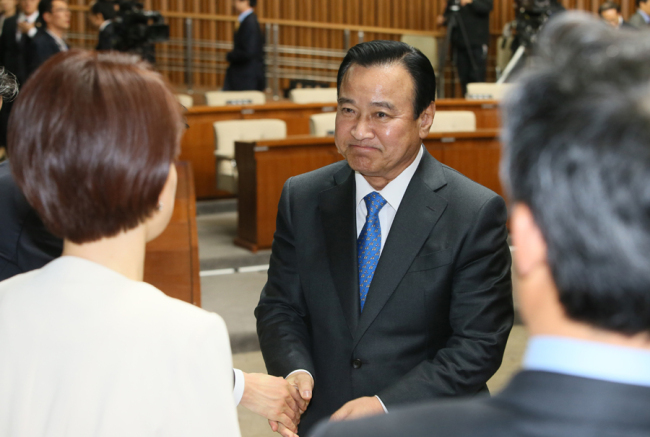
Rival parties agreed Thursday to postpone a vote on the nomination of Lee Wan-koo as prime minister following heated disputes over alleged ethical lapses and intimidating remarks to journalists.
The former Saenuri Party floor leader was nominated late last month by President Park Geun-hye. But allegations of conscription evasion, real estate speculation, and the disclosure of a recording of a recent conversation in which the lawmaker appeared to threaten reporters who wrote critical stories of him brought criticism of his appointment.
A plenary meeting to vote on Lee’s nomination was scheduled for Thursday. But worsening partisan strife over the appointment compelled lawmakers to postpone the full session to Monday.
Even though it appears Lee will receive parliamentary approval in Monday’s plenary vote, it will be difficult for him to wield any genuine authority as prime minister in the foreseeable future, experts said, as public opinion against the third-term lawmaker is unlikely to fade quickly.
 |
| (Yonhap) |
The majority Saenuri Party supports Lee’s nomination. The main opposition New Politics Alliance for Democracy is against the move.
The NPAD threatened Thursday to boycott the parliament and indefinitely stall the passage of some dozen bills strongly supported by the governing party and President Park if the Saenuri Party uses its majority to railroad the confirmation motion. The Saenuri Party holds 158 seats in the 295-strong parliament.
The bills are central to President Park’s proposed economic restructuring policies. The draft laws include those aiming to facilitate crowd-funding, legalizing telemedicine, and revisions to laws that currently ban the construction of casinos near public schools.
The NPAD has the ability to resist the bills as NPAD Rep. Lee Sang-min holds the chairmanship of the Assembly’s Legislation & Judiciary Committee. The committee chief is authorized to indefinitely block bills from being forwarded to a final legislative voting.
“The recent public backlash at allegations against Lee and a boycott by the opposition is likely to force the prime minister nominee into an involuntary silence on policy issues,” Yonsei University professor Yang Seung-ham said.
But NPAD officials must also risk political damage if they resist Lee’s nomination, analysts say.
At stake is the Chungcheong region, the home provinces of Prime Minister nominee Lee. He also served as South Chungcheong Province’s governor from 2006 to 2009. The swing region is a usually heated electoral battleground in South Korean elections.
If the NPAD continues to stall Lee’s nomination, the party must risk losing votes in Chungcheong in future elections, including next year’s parliamentary polls, which could affect the 2017 presidential race.
The NPAD’s chair, Rep. Moon Jae-in, elected to his post last Sunday, is also under pressure to resist Lee’s nomination by party hard-liners.
Moon must appease them while simultaneously ensuring that his party is not seen as an overly dogmatic group that is impeding government efforts to revive a struggling economy.
By Jeong Hunny (hj257@heraldcorp.com)

