


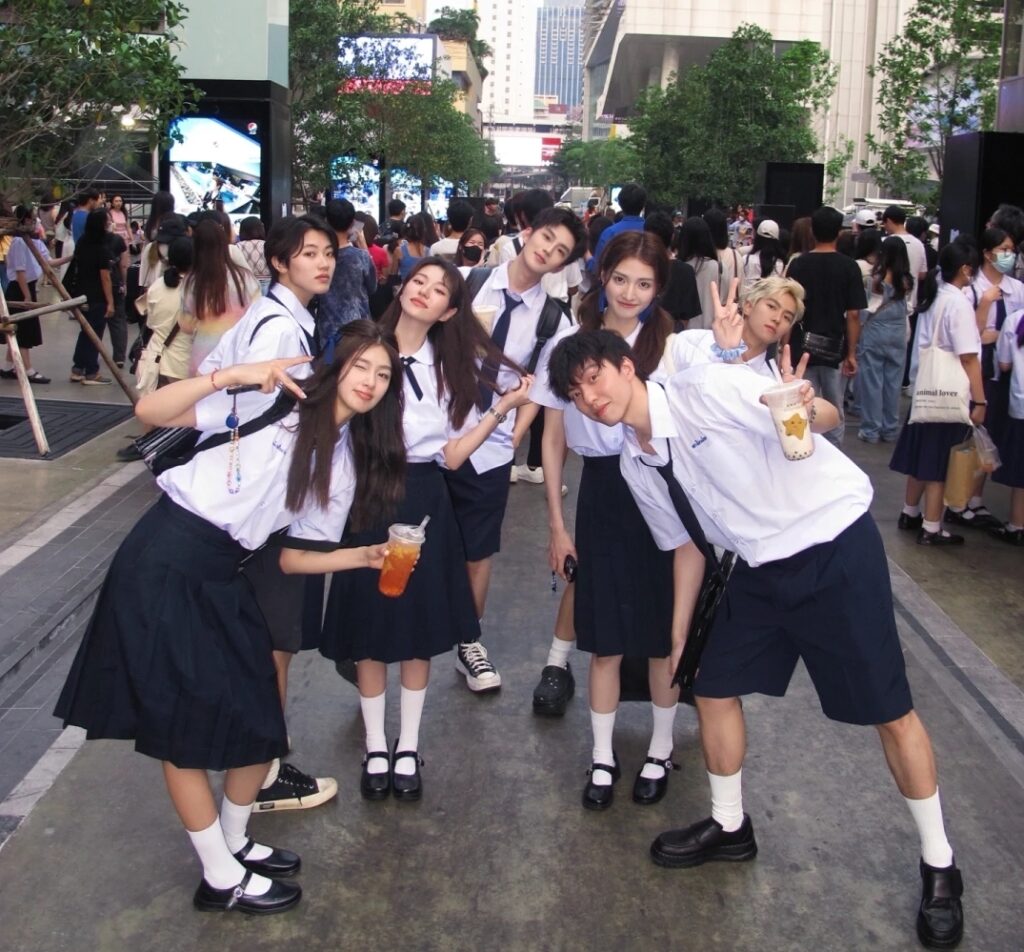
As the border, which had been closed due to the novel coronavirus infection (COVID-19), has been opened, Chinese people are traveling abroad. Chinese people are pulling suitcases and visiting various parts of the world, focusing on neighboring countries such as Vietnam and Thailand. Among them, some Chinese tourists who visited Thailand are taking pictures after purchasing and wearing school uniforms of middle and high schools. It’s a kind of travel certification game. The unique culture of Chinese tourists, who have created a travel atmosphere by taking photos of their school uniforms 10 years ago, is being restored with the resumption of travel. In Thailand, students wear school uniforms in elementary, middle, and high schools as well as universities, and the design is evaluated as excellent.Chinese tourists’ certification of Thai uniforms is attracting attention from various foreign media. It has been about a month since the opening of the border started the Chinese overseas travel in earnest. First of all, in Thailand, where school uniform certification games are held, the Bangkok Post posted an article on taking pictures of school uniform certification on the 9th. After gaining popularity for a while, we looked at the background of the re-population after it withered. He also said that wearing school uniforms outside the school could violate the “Thailand Student Uniform Act.” The trend of Chinese taking photos of school uniforms is set in the Thai movies “The Love of Siam” (2007) and “Crazy Little Thing Called Love or First Love (2010). All of these films became popular in China, and major actors were shown in school uniforms in their works. Chinese celebrities join this trend and promote the spread of trends, and at the center of this resurgence is actor Zhu Jingyi, who was a member of the girl group SNH48. Last month, Jusjing visited the Central World Complex, a large shopping mall in Bangkok, and took pictures wearing school uniforms. Jusjing posted it on his Weibo account.
School uniform-related companies are naturally welcoming this trend. The owner of a Bangkok school uniform company posted a picture of Jusjing wearing her school uniform on his Facebook page. The report by Japan’s Nihon Keizai and Malaysia’s The Star, a week earlier, on the 19th, conveys the excitement of the school uniform industry. Regarding the trend, Yanjit Artsa Pricha Wang, CEO of Srifan, a school uniform company in Bangkok’s Banglampu region, said, “I have established a company and been in the school uniform business for more than 60 years, but this is the first time in history.” Since early this month, Chinese female tourists in their 20s have been visiting companies to buy uniforms. He also added that one side is buying school uniforms and the other side is taking photos of school uniforms.
A Thai citizen walks next to a signboard containing the phrase “Welcome to Bangkok” installed near a tourist attraction in the capital Bangkok on the 17th. In an interview with Malaysian media, he explained that the trend has not begun in earnest, saying, “The income is coming from the wallets of Thai students, not Chinese tourists.” The school uniform consists of a dress shirt with a ribbon tied to the collar and a knee-length skirt. Boys’ uniforms consist of white shirts and shorts. School uniforms for girls are sold for 600 baht ($17) at Srifan, a school uniform company. Since it is mandatory to wear school uniforms, there are several school uniform companies in Thailand. Pratchat business recently surveyed 178 school uniform manufacturers and announced the top three brands. The culture of wearing school uniforms for Chinese tourists is a phenomenon similar to foreigners wearing hanbok and giving off the travel atmosphere to their heart’s content around the five major palaces in Seoul, including Gyeongbokgung Palace. There are some differences. Unlike many foreigners wearing hanboks around palaces in Seoul, Chinese travelers wearing school uniforms are not often seen in tourist attractions. Taking pictures of hanbok offers the benefit of renting clothes, wearing them, returning them to companies, and free admission to Gyeongbokgung Palace. You should not engrave your name or damage the borrowed hanbok. Taking pictures of school uniforms that are popular in Thailand is often done by purchasing them. Tourists also engrave their names and phrases on their clothes on their uniforms.
Some people have negative opinions about this trend unique to Chinese people. Some argue that the trend of tourists wearing school uniforms will have a negative impact on students who insist on liberalizing their clothes. In Thailand, where even college students have to wear school uniforms, a movement to liberalize the school uniforms of tourists was also held, centering on students from Jwalalongkorn University and Tammasat University. Not all school uniforms are acceptable. In Thailand, some experts warn that wearing school uniforms with school logos and doing outside activities could cause legal problems. “If you wear a school uniform when you are not a student, you can be fined up to 1,000 baht for violating the School Uniform Act,” said lawyer Rachapon Syrizacon. “It is illegal to engrave the school name on the school uniform.” It is explained that it is against the law if you attach a badge or engrave your name so that others can recognize it.
However, it is not too illegal to include the wearer’s own name, Rachapon explained. Education Minister Tlinut Tiyentung also confirmed that “it is not a problem if the name of a specific school is not attached to the school uniform.” “(Wearing school uniforms) is part of tourism, and if it is a good trend without harm, it is necessary to understand it as a tourist culture,” he stressed. “There have been no reports that tourists in school uniforms have gone to inappropriate places or used them for night culture,” Minister Tlinut said. “(Chinese wearing uniforms) is the same concept as wearing outdoor clothes we wear when hiking or outdoor activities.” In the meantime, he also brought up the case of Japan. In the past, the culture of wearing school uniforms was also popular in Japan, which was positive in promoting Japanese culture. Some predict that the culture of taking pictures of tourists wearing school uniforms will ultimately strengthen Thailand’s image and soft power. Along with Minister Tlinut, Thanet Pechwan, deputy director of the Thai Tourism Agency (ATA), expressed a similar view. Regarding the wearing of school uniforms and photo certification, Deputy Commissioner Thanet said, “It will increase the influence of Thai tourism culture and help Chinese tourists visit Thailand.” Last year, the Thai government appointed a committee to strengthen soft power led by the prime minister’s office. Considering that Chinese account for a large proportion of all tourists, the Thai government is also likely to make efforts to spread the culture of school uniform certification.
The Thai Tourism Organization expects 7 to 8 million Chinese tourists to visit Thailand this year. This is an increase from the original estimate of 5 million. The total number of foreign tourists to visit Thailand is expected to reach 25 million to 30 million, according to the Thai Tourism Administration. In 2022, when COVID-19 was in full swing, about 11 million foreign tourists visited Thailand. At that time, the number of visitors was also higher than the original target of 10 million. However, this number is far short of the 39 million foreign visitors in 2019, just before the COVID-19 pandemic.
Sophia Kim
US ASIA JOURNAL

