


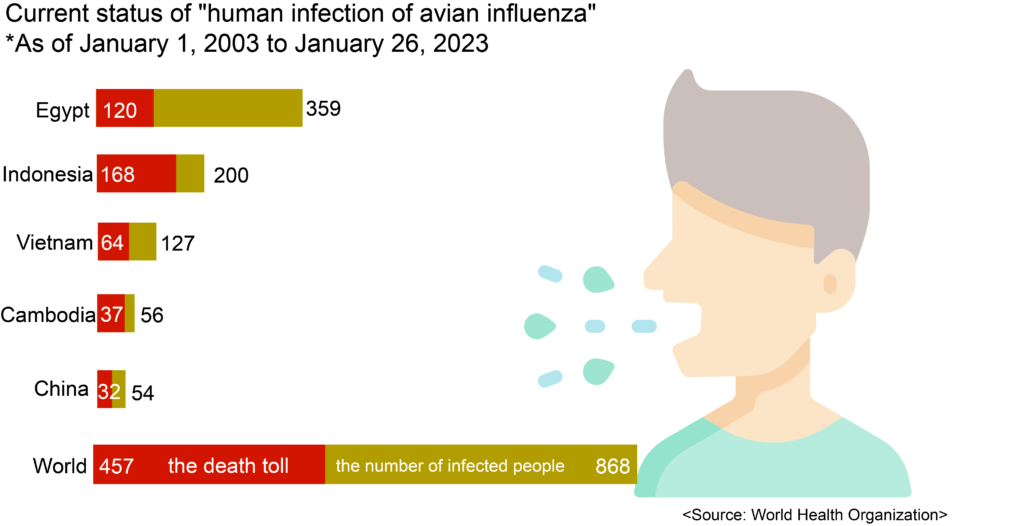
As the worst avian influenza (AI) outbreak in the U.S. expands, there is a growing concern that humans will be infected. As a result, there are calls for vaccination of birds, but the chicken production industry is strongly opposed. “After tens of millions of chickens were killed or killed by AI, the U.S. government is considering vaccinating poultry such as chickens, turkeys, and ducks,” it reported. Since last year, more than 58 million poultry have contracted AI in 47 U.S. states, and the H5N1 virus, which causes AI, has also spread to mammals such as mink, fox, raccoon, and bear.As the H5N1 virus spread widely from birds to mammals, there were concerns that it could mutate and spread to humans. For the first time since 2003, when statistics began to be released, AI infections occurred in the United States last year. According to the World Health Organization (WHO), 868 people have contracted AI around the world over the past 20 years, of which 457 (52.6%) have died. Last month, an 11-year-old girl died of AI in Cambodia.It is evaluated that the probability of AI being transmitted to humans is still small. However, the U.S. administration, which has suffered from COVID-19, which seems to have spread through bats, has begun to prepare for the contingency of AI spreading to a second pandemic.The U.S. Food and Drug Administration (FDA) sent virus samples to pharmaceutical companies to develop AI vaccines that can be administered to humans, and the U.S. Centers for Disease Control and Prevention is looking for a doctor to develop an H5N1 virus diagnostic device.Some argue that the possibility of human infection should be reduced by vaccinating poultry first, but meat companies are strongly opposed to the vaccinated chicken because it is less competitive in exports. U.S. chicken exports amounted to 6 billion dollars (about 7.7922 trillion won) a year.In addition, some analysts say that it usually takes three years to develop a vaccine and two years to inoculate all poultry.Meanwhile, due to the AI crisis, the average price of 12 eggs in the U.S. rose 2.5 times from 1.929 dollars in January last year to 4.823 dollars in a year.
SOPHIA KIM
ASIA JOURNAL
