


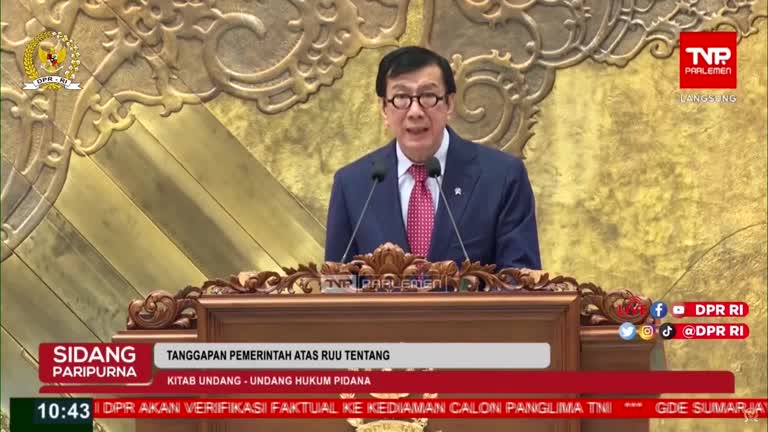
Indonesian lawmakers congratulated themselves on replacing the old criminal law, which dates back to the Dutch colonial period. If you look at the contents, it is difficult to say that “modernization” has been achieved. It is evaluated that it excessively regulates individual private areas and runs counter to the global trend of de-religiousizing the law. Not only Indonesian citizens but also the international community are raising concerns. How will this amendment change Indonesian society in the future? I looked into the contents.
The law against extramarital sex?
Above all, this amendment is collectively referred to as the “Prohibition of Out-of-Marriage Sex Act.” This is because Article 411 stipulates that extramarital sex is punished by imprisonment for not more than one year. Previous criminal law only considered extramarital sex of “married people” to be subject to prosecution and prosecution. The new law covers not only ‘married’ but also ‘unmarried’ extramarital sex. Naturally, it has the effect of banning sex before marriage.This is particularly problematic in that Indonesia does not allow same-sex marriage. Although the law does not specify how to view same-sex sex, it is fundamentally impossible to obtain legal marriage status, so all same-sex sex becomes extramarital sex. Human rights groups are concerned that it is tantamount to criminalizing same-sex relations. Furthermore, Article 412 stipulates that couples who do not legally marry and live together as “husbands and wives” can also receive six months in prison. This can also make those who cannot marry legally for many reasons, minorities with different religions and customs, and sexual minorities more vulnerable.

The law also stipulates that women who have terminated pregnancy, excluding emergency situations, are sentenced to up to four years in prison, and those who help abort pregnancy are sentenced to up to five years in prison (Article 463 and Article 464). Education and information on contraception and abortion are also prohibited. Human Rights Watch (HRW), an international human rights organization, said, “This retreats the right to sex education and reproduction under international law,” adding, “The lack of options for unintended pregnancies can affect girls’ suspension and early marriage.”
The Indonesian tourism industry is on alert as the criminal law is known to apply to foreigners such as tourists. In other words, unfavorable factors have been added to the tourism industry, which has barely recovered from the COVID-19 pandemic. Bali, where Koreans also often visit as vacation spots and honeymoon destinations, is a representative example. Maulana Yusran, deputy director of the Indonesian Tourism Industry Council, said, “This law is completely counterproductive (to tourism recovery). I’m deeply sorry,” he told the Guardian. Bloomberg said, “It is uncertain whether couples traveling to Indonesia will be closely investigated, but the Indonesian government said it will only take action if accusations come in and will not crack down.” “Criminalizing individual private decisions will affect many companies that decide whether to invest in Indonesia,” said Sung Kim, the US ambassador to Indonesia. It could result in a reduction in foreign investment, tourism and travel,” he said
I did.
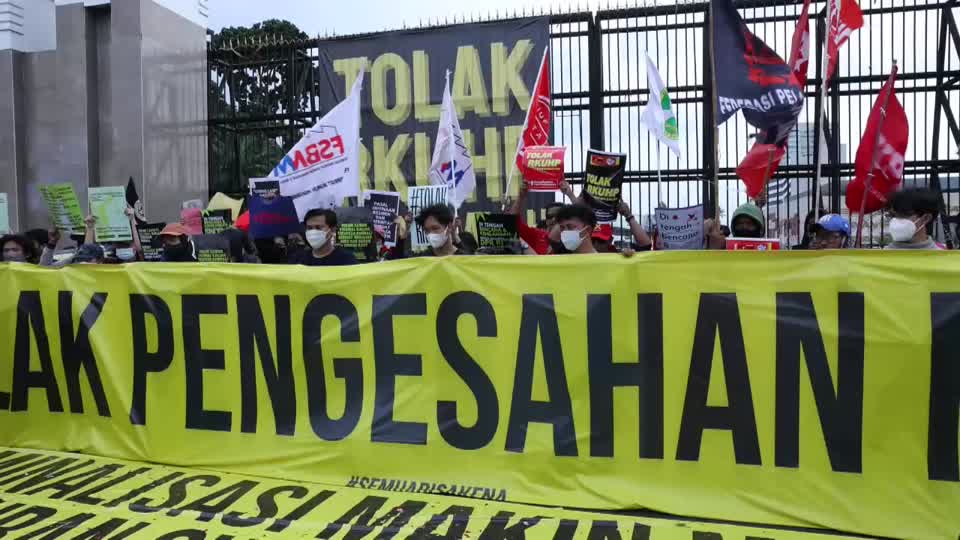
There’s a lot of trouble from the start…”Democratic retreat”
The law also has room to threaten democracy and freedom of speech, religion, and expression. A person who tries to sway Indonesia’s national ideology of “Panchasila” can be sentenced to up to five years in prison (Article 190). Defamation of the president or vice president constitutes a three-year prison term (Articles 218 to 220). Those who create rioting fake news, inaccurate, exaggerated, or inaccurate news are also subject to punishment. Demonstrations without prior permission are also illegal. The crime of blasphemy, which was stipulated through one provision in the previous criminal law, has increased to six provisions in this amendment. Indonesian political analyst Arya Fernandez told the Financial Times that it was “a clear retreat of democracy and freedom.”
Initially, Indonesian President Joko Widodo tried to pass the bill in 2019. Hundreds of thousands took to the streets to protest. Public sentiment has worsened, with deaths occurring as a result. The problems of this bill, which arose at that time, are also similar to today’s perspective. Since then, the discussion has been slow due to COVID-19 Recently, a drive was caught and it was not difficult to cross the threshold of parliament. Criticism remains that the process of enacting the bill was unclear and that social public debate was insufficient.
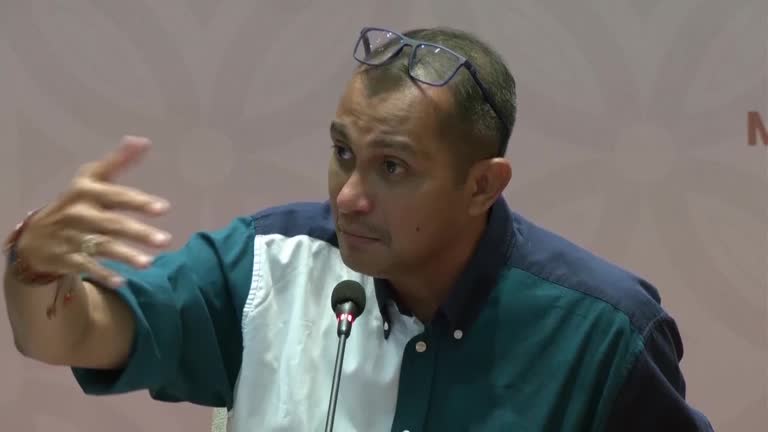
How could the bill, which had already raised many problems for years, have been passed? It is interpreted that the interests of the Indonesian government, which needed stronger tools to control the public, nationalist parties that wanted to defend Panchasilla against Islamic conservatism, and Islamic parties that wanted to reflect Islamic values such as banning extramarital sex. It is also believed that President Joko Widodo urged the passage of the bill this year so as not to affect the 2024 presidential election. President Joko Widodo, who is currently serving a second term, is unable to run in the next presidential election, signaling a political realignment in Indonesia.
The revision will not take effect until up to three years after drafting and signing by President Joko Widodo. But the confusion has already begun. Indonesian civil society is also moving to send the law to the Constitutional Court. Political expert Jefferson Ng pointed out, “The new criminal law provisions are not clear, causing uncertainty for companies and individuals who do not know exactly how the law will be enforced or what actions are tolerated.” The Indonesian government also emphasizes that “tourists will not suffer any damage” to the ban on extramarital sex, which is receiving the most attention. Dr. Dish Seymand Juntak of the Yusoph Science Institute in Singapore, however, said, “Selective enforcement can be carried out targeting specific industries or hotels for bribes.” Indonesian worker Dimas, 25, said, “The government should pay more attention to important issues such as climate change, jobs, and wages than to citizens’ sex lives. Life has become difficult due to the economic recession and job shortages. I think the government is using the new law to divert attention from these issues,” he told the Guardian.
KS CHOI
ASIA JOURNAL

