


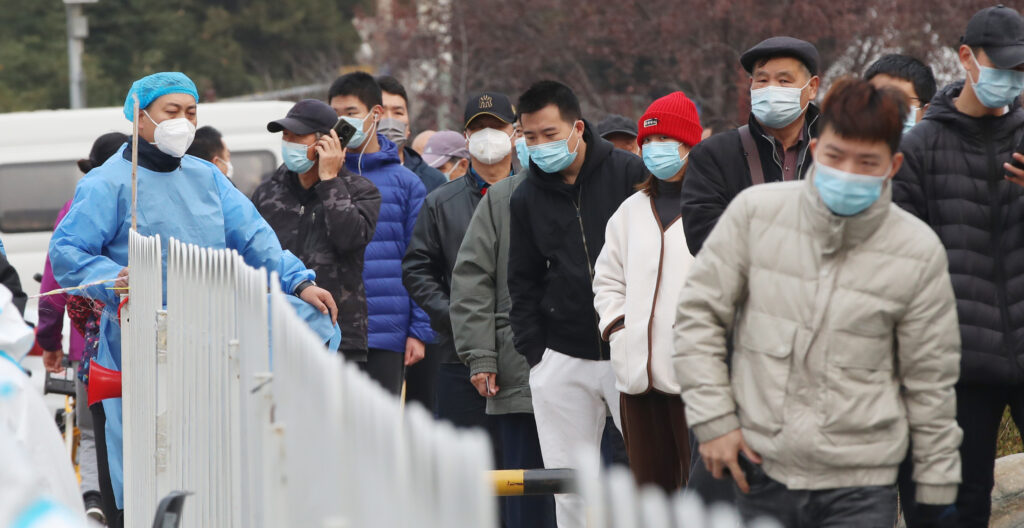
On the 22nd, China’s National Hygiene and Health Commission announced that the number of new confirmed cases in mainland China reached 27,899 the previous day, including 25,754 asymptomatic cases. Adding 228 cases of overseas inflow increases the total number of new confirmed cases to 28,127. It is closer to the highest number recorded on April 13 (28,973). By region, there were 9,022 people in Guangdong, 6,335 in Chongqing, 1,438 in Beijing, 1,061 in Sichuan, and 997 in Gansu.
Beijing city authorities began to block the steep increase in the number of confirmed cases from the same day. Banning eating in restaurants, telecommuting, and switching online classes, which took effect on the weekend, continued, and Ewha Womans University and Beijing Olympic Park suspended operations from the 22nd. Starting from that day, those entering Beijing will conduct three nucleic acid (PCR) tests for three days, and movement will be restricted until the PCR test results are negative.
In particular, Chaoyang-gu, where confirmed patients are concentrated, ordered libraries, movie theaters, sports facilities, and closed entertainment establishments, as well as restaurants, food stores, beauty salons, and karaoke rooms. Some apartment complexes restrict food delivery and delivery.
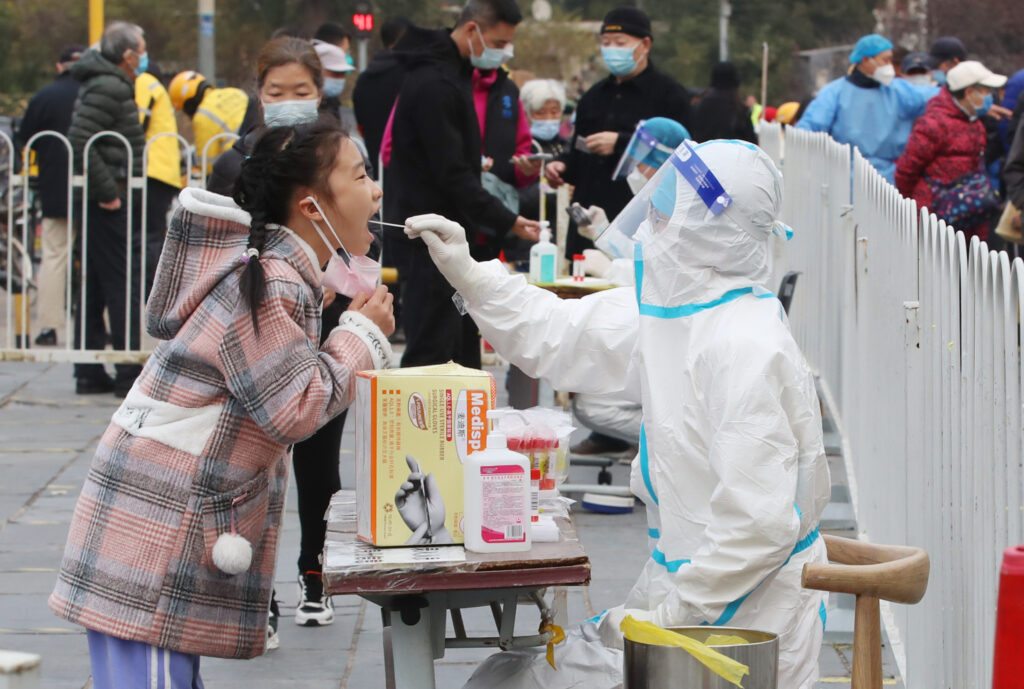
In fact, the capital city of Hebei, China’s northern province of Xujwa, which had become a “test for quarantine mitigation,” was also blocked. When China’s quarantine authorities announced 20 measures to ease quarantine on the 11th, Xu Zhujiang closed the free PCR regular inspection center on the 14th, saying it would not check PCR results in some public places. However, as the number of confirmed cases increased rapidly, the government began to block all of them, such as banning them from going out and conducting a full inspection.
According to China’s state-run Xinhua News Agency, China’s Deputy Prime Minister Sun Chun-ran, who is in charge of quarantine, visited Chongqing on the 21st and said, “We will minimize the impact of infectious diseases on the economy, social development, and the livelihood of the people.” “This is the first time that Deputy Prime Minister Sun has appeared on the scene since the Chinese government announced the new COVID-19 policy,” he said, pointing out, “It reflects the growing situation.”
KS CHOI
ASIA JOURNAL

