


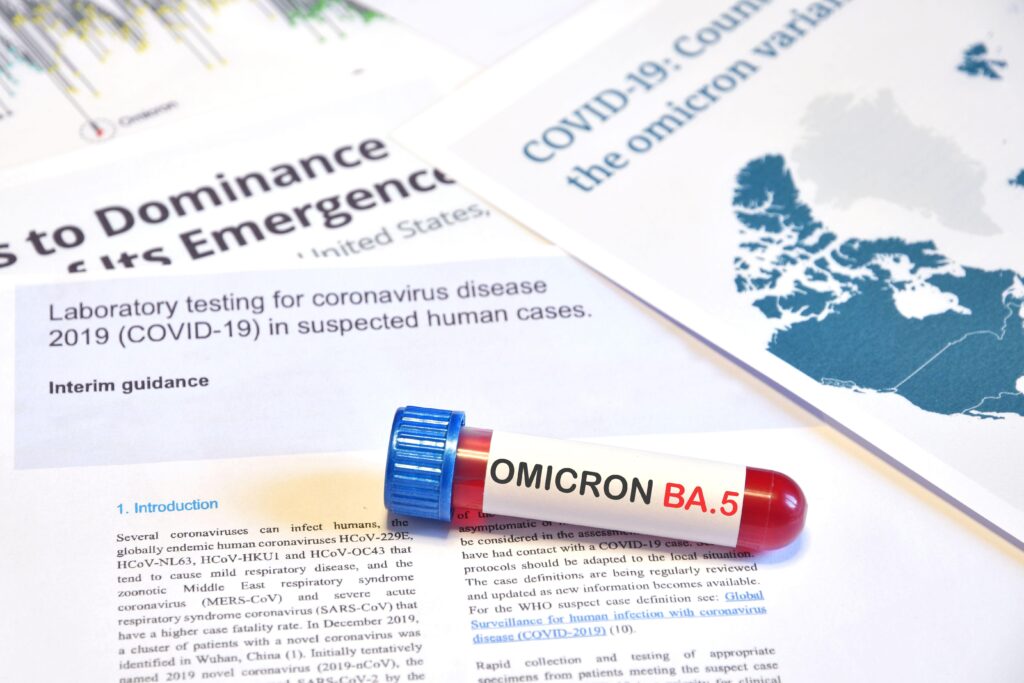
2JE5N7P Blood tube for test detection of Virus Covid-19 Omicron BA.5 Variant on papers document. Concept for the New Variant from Virus SARS-CoV-2 “Omicron BA
The Korean quarantine authorities predicted that the re-pandemic of COVID-19 will occur between August and September. It is up to four months earlier than originally expected from November to December. It is interpreted as a combination of the prevalence of new mutations such as a decrease in natural immunity and vaccine immunity, and BA.5, which has strong transmission power and immune avoidance power.
The authorities plan to start quarantine centered on high-risk groups in preparation for the summer re-pandemic. To this end, measures such as the introduction of additional vaccines and treatments, securing beds, and expanding the fourth vaccination were announced. The reintroduction of social distancing is not immediately considered. If the epidemic situation becomes more serious in the future, it plans to introduce it in stages.
BA.5’s appearance has also accelerated the re-pandemic period. “Up to 200,000 people in September”
On the 13th, the Central Disease Control Headquarters of the Korea Centers for Disease Control and Prevention unveiled three scenarios according to the spread rate of COVID-19.
Assuming the lowest transmission rate of 21.5%, it is predicted that it will peak at a maximum of 165,700 people on October 10. It was expected to be 23,300 at the end of this month, 78,800 at the end of August, and 155,800 at the end of September.
Assuming the intermediate stage of 31.5%, it is predicted that a peak of 184,700 people will appear on September 26. The trend is expected to be steeper at the end of this month, with 30,000 at the end of August, 111,800 at the end of August, and 182,300 at the end of September.
Assuming the highest transmission rate of 41.5%, up to 206,600 confirmed cases are expected to occur on September 16. The number of confirmed cases is expected to increase sharply in August to 38,300 at the end of this month, 161,000 at the end of August, and 173,900 at the end of September.
It is two to three months earlier than November, which was presented by the Central Disease Control Headquarters as a forecast for the second half of April.
In the case of private researchers requested by Central Disease Control Headquarters for modeling predictions, all six teams predicted that more than 50,000 confirmed cases would occur in August. The four teams predicted that more than 100,000 confirmed cases will come out in September. The peak period varied from mid-August to early October, and the scale was also suggested from 100,000 to 165,000 people. It is predicted that the number of critically ill patients will increase to a maximum of 1,450 and the number of deaths will increase to a maximum of 150 a day.
Authorities assessed that the epidemic is spreading earlier than expected as natural immunity and vaccination immunity from Omicron mutations are decreasing, and BA.5 mutations, which have high transmission power and avoid immunity, are becoming dominant.
Baek Kyung-ran, head of the Korea Centers for Disease Control and Prevention, said, “The government and authorities have been continuously preparing for the second half of the year in anticipation Considering the currently secured response capabilities such as vaccines, treatments, test capabilities, and medical beds, it is enough to handle epidemic predictions, he said. “We will make the most of our current response capabilities and respond preemptively to changes in the epidemic situation.”
Authorities “Enough medical capacity… Vaccines, drugs, speed of beds
The authorities are not planning to respond to the current social distancing policy, but to the current medical system.
First of all, it decided to purchase more than 900,000 additional eating treatments and actively prescribe them to patients in need of medicine. Authorities currently have about 780,000 doses of eating treatments such as Paxrobead and Lagebrio. As of the 8th, a total of 1,062,000 people were introduced and 284,000 of them were prescribed.
It will also expand the institution for prescribing medicines to be taken. In July, 327 general hospitals and 692 hospital-level respiratory patient treatment centers will be able to prescribe treatments.
The obligation to quarantine COVID-19 confirmed patients for 7 days will be maintained.Korea is already testing COVID-19 FREE. The decision is based on the judgment that lifting the obligation to quarantine confirmed patients will accelerate the spread of the epidemic. It will also extend measures to acknowledge confirmation when testing for rapid antigen testing (RAT) for experts is positive. The necessity of rapid inspection and treatment linkage was considered when the epidemic spread. The free PCR test capacity for high-risk groups remains at the current level of 850,000 per day. The expansion and operation of temporary screening clinics will be reviewed after observing future trends.

One-stop medical institutions that can receive tests, prescriptions, and treatment in one place will expand to 10,000 in July. If more than 100,000 confirmed patients occur a day, the operation of the residential treatment center, which had been suspended, will be reviewed. It plans to operate at least one life treatment center for each city and province.
Considering the trend of confirmed patients, the number of beds that had been reduced to 5,700 will be expanded again. It plans to secure 1,400 additional beds in preparation for the occurrence of up to 200,000 people. Additional negative pressure beds for special patients such as delivery, dialysis, and pediatric treatment will also be secured by the end of July.
Director Baek said, “The world is facing the spread of new mutations, but our response capabilities are different from before,” adding, “The government will do its best to manage the COVID-19 crisis sustainably and scientifically using prepared quarantine and medical countermeasures.”
TED PARK
ASIA JOURNAL

